


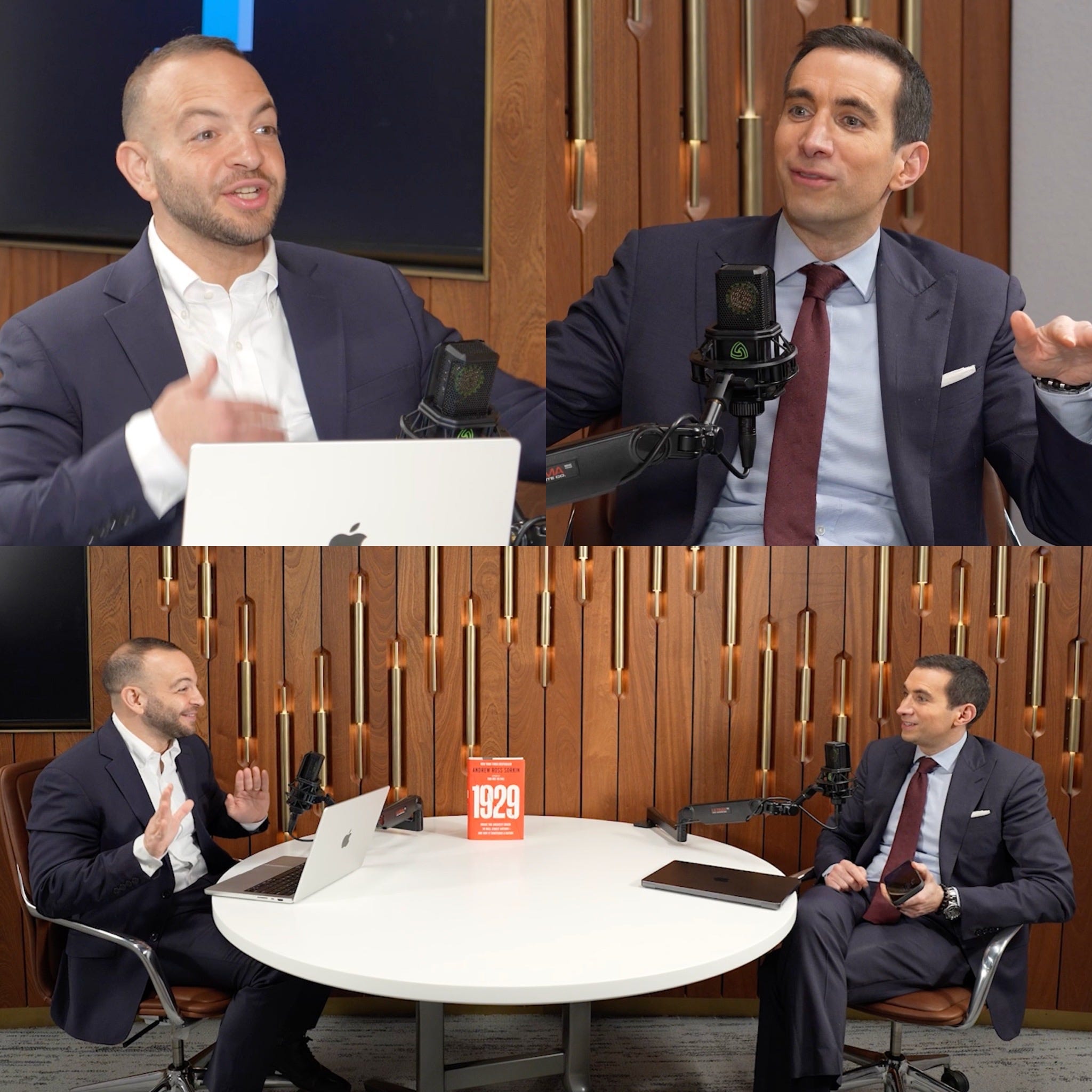
When Andrew Ross Sorkin released his book on the 1929 stock market crash last year, the prevailing worry was that the debt-reliant AI buildout might end in disaster. Now, six months later, the market is freaking out about AI’s potential to succeed. Every Anthropic blog post seems to cause a mini-meltdown in software stocks and unease about AI’s potential to replace jobs is building fast.
So, this was the right moment to check in with Sorkin, a CNBC anchor and New York Times columnist, about whether today’s set of concerns about AI’s success are warranted, and whether they could hit the market hard if realized. In an hour-long conversation at the New York Stock Exchange this week, we covered the labor and capital side of AI, how the AI bet might impact private credit, prediction markets, the SpaceX IPO, and plenty of other ground.
You can read our full conversation, edited lightly for length and clarity, below. Catch it next Wednesday on Big Technology Podcast, which you can subscribe to on Apple Podcasts, Spotify, or your podcast app of choice.
Alex Kantrowitz: Hi Andrew, Market crashes are typically caused when debt goes bad. So how do you evaluate the current concern that AI works and everything is disrupted?
Andrew Ross Sorkin: I’m often asked, is there a modern day way to get to 1929? And what people are really asking is, is there a modern day way to get to 1932 — which is 25% unemployment in America?
I always think the answer is actually less of a market crash and more AI. If you ever wanted to think about what would this country look like with 25% unemployment, how would you get there? And I think the answer is, potentially, if AI is as successful as I think we all hopefully want it to be — to the extent you believe these valuations are real — all of the math behind it, the only way that really works to some degree, is to create extraordinary productivity. And what does productivity mean? Well, it means a lot of growth at a lot less cost. How do you take out that cost? Well, we’re both looking at each other, and that’s pretty much — we are the cost.
The robot employee is going to be a thing.
It’ll definitely be a thing. My kids talk about it being a thing. I’ve got 15-year-old boys, and we talk about what they’re going to do. But then we talk about, literally, are we going to have a robot in our house in five years from now, and what are all the things that the robot is going to do?
I am skeptical that AI is going to cause this wave of mass unemployment. If it’s able to do the jobs of, let’s say, 20% of the workforce — wouldn’t you anticipate a production boom that would come along with that and help grow the economy?
That, to me, is the question. It’s not, are there more things to do — it’s who’s going to have the money to do those things?
I don’t think that we have to have mass unemployment forever, either. I think it’s possible that there could be a painful transition period. And historically, when we’ve gone through these technological revolutions, there have been painful transition periods. And so if you’re a young person today, doing the job that, frankly, increasingly it appears that a Claude or ChatGPT could even do — whether it’s research or putting together a model or being a paralegal, or name your role — you say to yourself, if you’re running one of these firms that historically hired kids out of college to do that, are you going to still hire those kids to do that? Is there a higher order kind of work that they can do for you now that you can get this work done by the AI? I think these are the real questions.
And then there’s going to be an economic one, which is, tokens are not free. AI is not free. But how much cheaper is it ultimately going to be than a human?
Our conversation continues below…
A MESSAGE FROM OUR SPONSOR
See autonomous AI in action

Feeling forced to choose between AI innovation and control? Discover how
agentic AI can deliver both — completing requests end to end, securely and with enterprise-level governance. The result: faster outcomes, stronger oversight and more capacity for high-impact work. Watch the demo.
When you look at the statistics, though, it’s very interesting — AI is more sophisticated in coding than anything else, but we’re definitely not seeing a wave of layoffs of software engineers now.
You don’t think that in two years from now, just in terms of the magnitude step change in how good the technology is going to be, that it’s not going to get that much better? I agree, if this is the level, I’ll bet with you. But if you believe in the technology improving — which invariably it has to — and by the way, if it doesn’t, then we’re in a whole other different world. Then we’re not talking about what happens in success. We’re talking about what happens in failure, because then we really will have a bubble.
But if it doesn’t improve the way I think the model makers — policymakers, investors — want it to, I just don’t see how we’re going to be sitting around doing our own programming. I just don’t see it. By the way, I write my own articles today. I wrote this book without AI. This took eight years, unfortunately. But five years from now, do you really think that people are going to write books even by themselves? I assume you will be co-authoring a book with AI. I imagine people will be writing articles, at minimum, with AI — if AI is not doing it entirely, in which case, then there’s a question about what is the role of the human in all of this.
The thing that I wonder about is whether businesses in the economy will be content with what they’re doing today or just go after their roadmap in a way they’ve never been able to before, because they’ve been constrained by labor.
That generally assumes that then you have to be able to massively upsize the size of the pie, right? This is growth for everybody. But there is some of this that is a zero sum game. It is not like the pie can just grow exponentially. I know there are people who believe that it could, but invariably, at least historically, it hasn’t.
So yes, I imagine there’ll be people who do even more. But I would also say — I walked in here and I described you as an independent media titan, right, in this role that you’re in. You’ve got a sort of satellite group of people who you use and work around you. And maybe over time, you hire some more people here and there, but maybe you wouldn’t in the future, and maybe the sort of network that you’ll have will be your agents that will do this for you. Well, if you don’t have those people doing that work for you, what are those people doing?
I myself am a little bit of a small business. As I was promoting my book, I ended up having to hire a couple of different people — social media people, this and that. And I was sent a contract which I needed to fill out, and typically I would have sent it off to a lawyer who would have charged me, I don’t know, a couple hundred dollars, maybe a thousand. And what did I do? I took the contract. I put it in ChatGPT. I said, tell me everything that’s good and bad in this contract. It spotted the things that I already saw and spotted some others. It then says, do you want me to redline the contract and mark it up? I say sure. It then says, would you like me to write a cover letter back? I say sure. I make some changes to it, I make sure it hasn’t hallucinated, and it’s off.
But it means that if every other small business owner operated the way I did in that moment, all of the lawyers who do business for small businesses for things that are not that complicated — these were contracts with very little at stake — I think people wouldn’t probably use lawyers for those things.
Now, then you say, well, maybe then the lawyers are going to have to figure out, can they be doing work that’s even higher grade? What is that higher grade work? We already have that higher grade work. It’s what big corporations look to them to do for mergers and acquisitions and other things. But the small business lawyer typically hasn’t been doing that work in the past.
That answer goes back to the question — is there going to be a limit on growth? If you were to take the example that you just gave, where now you’re able to go in and negotiate this contract with AI. Well, all of a sudden you get time back and you can work on improving your book, writing another article for The Times, researching a segment for the next day’s Squawk Box. You become that much more productive, right?
But I’m now not employing more people. So I do believe — talk about inequality — I believe that the wealth and the great riches are going to go both to the model makers, some of the big tech companies, and probably the folks who already have had success, because they will be at the top of these food chains, and instead of hiring more people, they’re going to hire more agents.
There are places though where I could definitely see some real disruption, like accounting. After watching Claude Code go out and build computer programs autonomously by following prescribed rules, it will probably be able to grab the code for a certain region and balance the books.
There’s much of that throughout our entire economy. Take journalism, for example. You’ve got a football game on over the weekend. You’ve got the scores. You know what happened during the game. The value proposition for a journalist to be watching that game and ultimately be reporting on it is their ability to analyze the game, potentially as a columnist, to be able to explain what happened in an entertaining way, but maybe have some insight into the player, maybe they had a relationship with the player, knew the player had been in the exact same position five years ago, and they have a whole bunch of different stats and all of these things.
Some of that — not all, but some of that — I imagine AI in the future will be able to replicate. There are other parts AI can’t do: walk into the locker room and start to interview the athlete, or figure out what the coach did two days earlier and try to get somebody to tell them something off the record or behind the scenes. And that’ll become a sort of higher order value proposition. But there’s a lot of things that are part of our daily life that I imagine will get automated.
This has existed for a long time though. Narrative Science is a company that’s been able to take the box score and turn it into a story. But we still love watching ESPN and watching live sports.
I don’t think we’re going to stop watching live sports. The question is, are we going to read about them in the same way? The service you described is looking at the delta between the scores, and then is able to describe what happened in a particular way. What happens when the AI can actually watch the game itself?
You know, if Sam Altman and Johnny Ive have their way, we will have something sitting on this desk probably in six months from now that may be watching what we’re doing all the time, right? In which case it’ll have a persistent memory about all of our interactions. And maybe if we’re watching the game, it’ll be able to report on the game itself.
Nothing will beat the reporter going into the locker room and speaking to the losers and winners. The people matter.
Google’s NotebookLM, for instance, makes amazing AI podcasts on any topic you could want. There was one podcast that hit the top 30 trending on Spotify that was entirely AI-created, about the Epstein files.
But by and large, we have the ability to create these shows, and we would still rather see two human beings have that discussion….
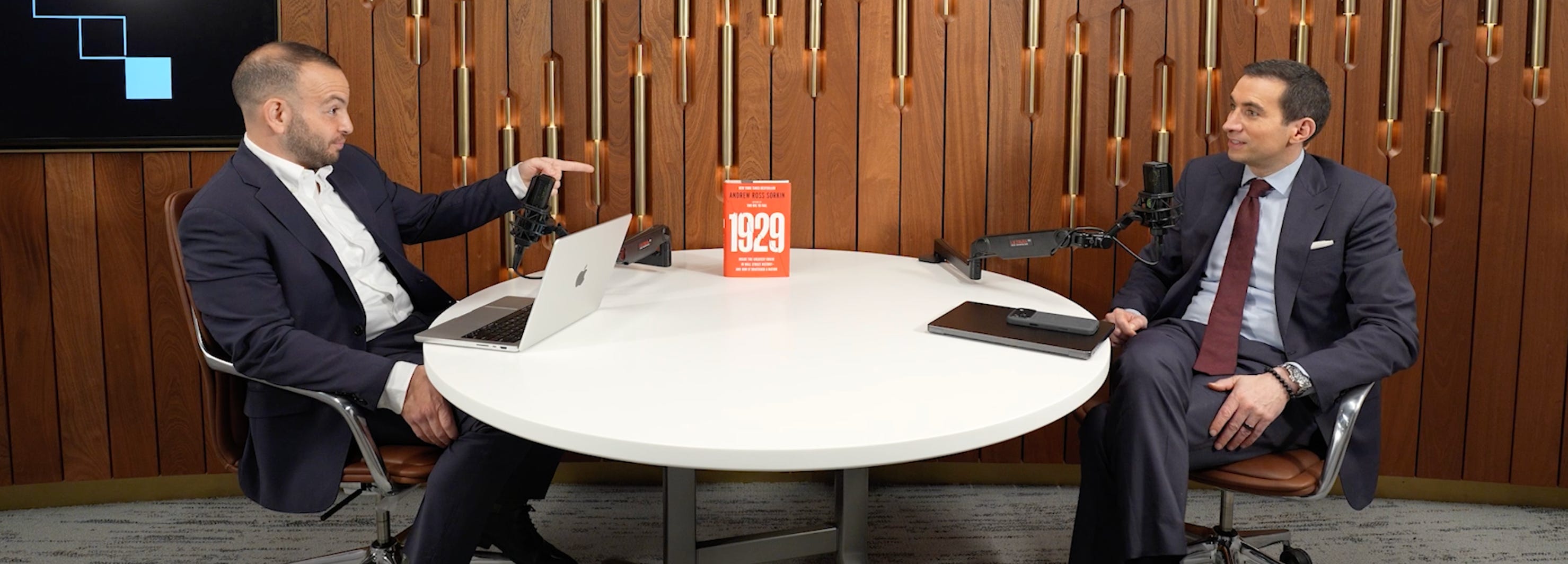
You’re freaked out by that Epstein podcast??
No — you’re actually giving me an idea. He just pointed, for those listening, he pointed to the book, 1929. I’m thinking maybe NotebookLM could put together an awesome podcast on 1929.
So there’s the labor risk, but there’s also a potential hollowing out of the software industry, and maybe other industries. It seems like we have these colliding forces where either the bet on AI needs to go bust or there’s going to be some serious consequences for everybody else.
So maybe I’ll be on the other side of this one. I’m not sure that software is dead just yet, because I think to myself, sure we can build our own model for whatever app we want to build for our company. But at the same time, a lot of these software companies already have an install base. They have some data. And on top of that, they probably should be — and are — using AI too to build their apps and their software. So I would imagine, unless you think that everything is just going to be built either by individuals and companies, or we’re all hiring Accenture to come in and just build custom software for everybody, I would think that some of these software companies will actually continue to have success.
The companies that are not the AI chatbot makers tend to think that there’s going to be a set of chatbots — there’s going to be a bot you use when you want to have a conversation like a ChatGPT style one, but one where you shop, and one where you’re doing your enterprise stuff and learning about what’s going on inside the company. I just see it consolidating.
I’m with you on that. I think we are all going to have one bot. Now the question is, does that bot do a sort of secret or quiet handoff to another bot, and it’s seamless to us, and we don’t even know — meaning our interaction is going to be just with our bot. And it’s not just that there’s one big model that’s going to do everything, but it’s that our bot says, oh, Sorkin wants to shop right now, there’s a specialty shopping bot over here, I’m just going to hand them off to that bot, and I’ll tell the bot everything I know about Sorkin so that it feels as if it’s the exact same bot working with them.
I think that’s probably going to happen, but the interesting thing is — I think this is the bet among many tech companies right now — they don’t fully know, we don’t know how good the core bot gets. So the reason why you would hand off to a shopping bot is because it’s difficult to build shopping capabilities into a general purpose bot right now. It takes a lot of planning, specialty knowledge. But once you get a bot that can do everything in this AGI way, maybe that need to specialize goes away, or maybe it can teach itself.
But I do think there’s going to be one interface that you will interact with.
Likely talking rather than even typing. By the way, I’m talking out constantly to my phone in a way that I wasn’t six months ago. Do you do that?
Definitely all the time. We have three Alexa Pluses in the house, and we’re talking to Alexa Plus all the time.
Are you typing your newsletter?
I’m typing it. I still believe in writing unassisted by AI, because to me, that’s the only way to think. Type it out.
What about texting? So my wife sends me a text saying, are you late? Which is typically what I am. And then it used to be that I’d write ‘yes’ or ‘I’m 20 minutes behind.’ And now I just say, yeah, I’m running late, sorry, I’ll be there shortly. I just feel like I’m doing that all the time now, a completely different way.
Now, you’ve said that if the AI companies can’t make good on all the money that’s been invested — and there’s a lot of debt there — then we could see some form of crash.
Has the fact that they’re starting to make real revenue made you feel a little bit better?
I feel better about it in two contexts. One is that they’re making more money. And two is that, I think when you really dig under the covers of a lot of these commitments that these companies have made to others — meaning data centers that are going to be built on the back end of these things, or even some of the investments we heard being made early on, saying they were putting in a hundred billion — when you realize that everything was tranched, those tranches make it safer, because it doesn’t mean that you’re going to go out and spend a hundred billion tomorrow even though you don’t have it today. So I do think that we’re hopefully in a bit of a better situation in that regard.
I still don’t think we’ve taken full account, though, of two component parts of this. What happens in great success from a technology perspective, in terms of the efficiency of these models? Could we ever get to a point where you actually don’t need all of these data centers, where a lot of the compute moves to the edge, and then all of a sudden the economics of that get upended? And then the other side is, could the depreciation schedule of these chips either be way shorter or way longer than we think? So I think there’s still a whole bunch of pieces of the puzzle that we haven’t figured out.
Yeah, that’s kind of one of the hypotheses we’ve been playing with on the show now — Did Apple just do it right? Where Apple becomes the infrastructure for AI, where it happens on your phone and on the Mac Mini, and the models become so efficient or purpose-built that you don’t need the data centers.
It may very well be that that’s where this lands. Having said that, I would imagine that this should be the greatest opportunity for Google and Alphabet to truly take share. Because Gemini, if built the way I think it should be built, should be able to move you around their phone in shocking ways. It should be able to move into any app, control any app, do everything throughout the phone.
I can’t imagine that Apple, which really has made its name around privacy and controls and a sort of walled garden, even under this new deal that they’re going to have with Google using Gemini as sort of their Siri, are going to let whatever that is go super deep throughout the entire phone. And so I would imagine that’s why I’ve always thought this should be Google’s time.
Private Credit
Let’s talk about debt. One of the interesting things that you’ve said repeatedly as you’ve discussed your book, is that if there’s too much leverage, that’s where you have the problems.
AI firms have been taking on a bunch of this debt for the infrastructure buildout. And I just find it astounding that we don’t know where the debt is in the system, because so much of it is happening in private credit.
I mean, look — we’re seeing right now a lot of hand wringing around private credit. A lot of questions about what that whole market is going to look like. And if that market seizes up, what does that do to lending in other parts of the economy? What does it do to real estate? You could see how it could have a big impact.
I will say one thing we haven’t really wrestled with is that the private credit business really can’t fall apart before, frankly, the private equity industry falls apart. Meaning, if you think about it, who has taken on the biggest loans from the private credit space? It’s oftentimes the private equity players, or some of these tech players. So the private credit people can’t lose money unless the other people lose money first.
And we really haven’t grappled with that, and that’s in large part because so many businesses today are private companies, and the marks, the valuations, are not in the public market. It’s not a day-to-day operation. And there is a whole universe that I’d put in the category of mark-to-make-believe, and the incentive system is such that you want that to go on as long as possible. Because if you are the equity owner, you don’t want to mark your position down, because then you can’t raise new money. And if you’re the private credit firm, you also don’t want them to mark it down, because it’s going to impact your own value. So you can see that it’s a cascading effect.
There are a whole lot of people who are holding on as tight as they can, hoping they can bare-knuckle this thing. Maybe we can get to a place where Kevin Warsh gets in the seat and we get some lower interest rates, and things kind of ease off, and maybe the world gets a little easier.
For those who aren’t fully into this — can you just briefly explain what this private credit, private equity thing is and why it’s not happening in the big banks?