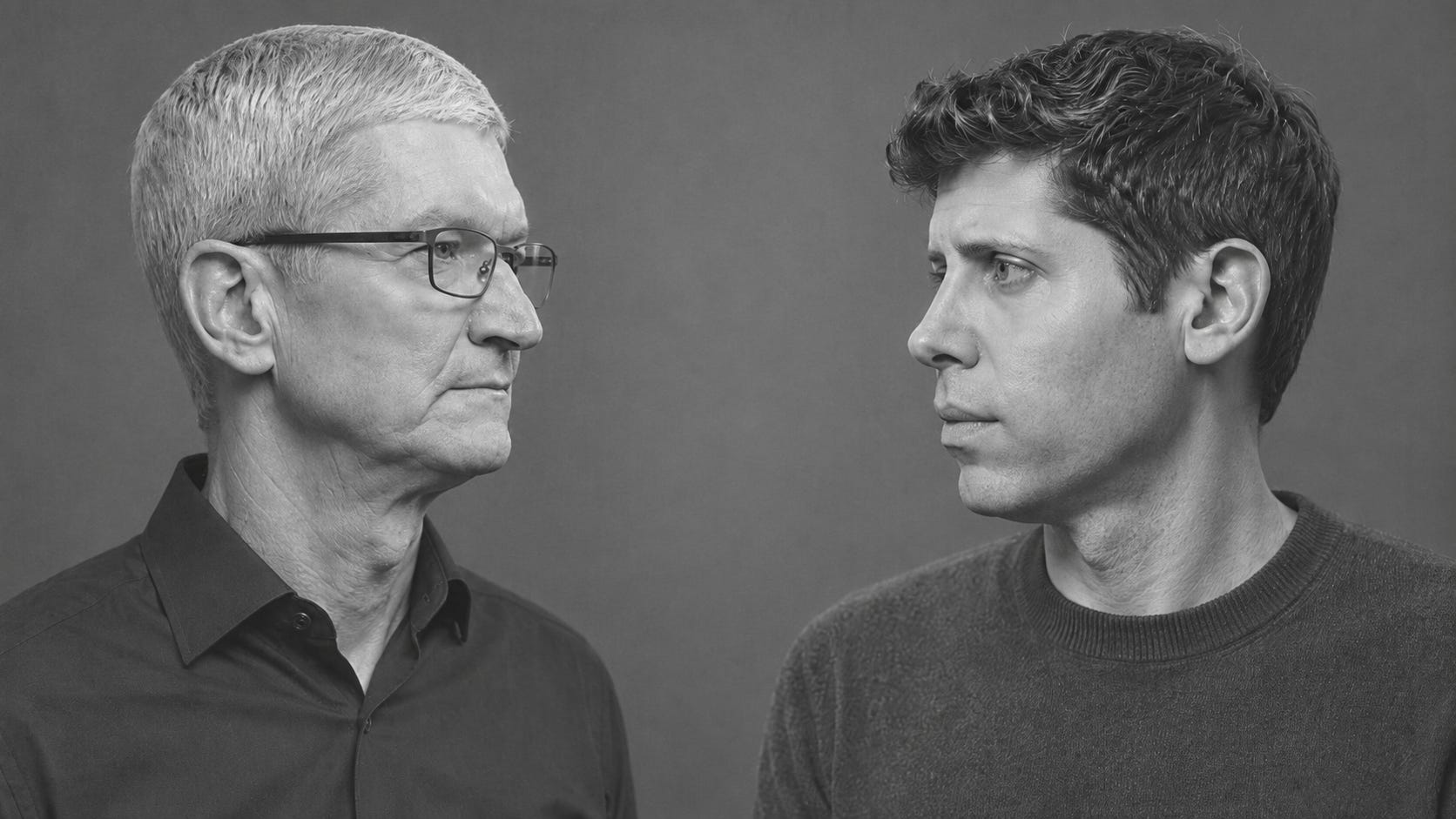
Apple’s lawsuit against OpenAI makes serious claims. Will they matter?
Apple usually tangles with companies after they ship a product, now it's going after a pre-product, former partner.
Apple doesn’t sue often. When it has, it’s usually gone after companies like Qualcomm and Samsung that are already shipping competing products. But now, it’s suing a pre-product rival with a complaint against OpenAI.
The lawsuit, filed by Apple on Friday, alleges theft of trade secrets and a months-long campaign to accelerate OpenAI’s hardware business. Defendants named by Apple include OpenAI and two former Apple employees including OpenAI chief hardware officer Tang Tan, a 24-year Apple veteran who led design on the iPhone and Apple Watch. The other employee named is former Apple engineer Chang Liu, who allegedly downloaded confidential files, including manufacturing and testing details for Apple’s circuit boards even after leaving the company..
If true, the claims detail what lengths OpenAI goes through to get ahead as a new entry in a massively competitive category: “Rather than investing what legitimate development would require, OpenAI has turned to trade secret misappropriation to free-ride off Apple’s decades of innovation,” the lawsuit said.
OpenAI said it has “no interest in other companies’ trade secrets” and remains “focused on building innovative technology that empowers people everywhere.” And in a reply on Saturday to a user on X, OpenAI co-founder Sam Altman seemingly commented on Apple’s lawsuit by saying “i am not afraid of apple, but i have tremendous respect for them. s-tier company.”
While some have likened the lawsuit to the infamous 2017 case between Waymo and Uber, the OpenAI lawsuit also has some parallels to a more recent case filed by Apple in 2022, when it alleged some former chip designers did something similar when they left to found Rivos, which the parties settled two years later.
A key unanswered question is how much did what OpenAI allegedly stole help it develop a product that has yet to release.
Apple says each category of trade secrets “derives independent economic value from its secrecy” and asks the court for injunctive relief, a jury trial, and discovery to help reveal the full extent of the alleged theft.
Even if Apple gets help from the court, it’s unclear if relief will even matter. If OpenAI did what Apple says, it’ll be hard to reverse the knowledge likely already applied to development of whatever OpenAI is developing — unless the court ordered a clear stop. Just like IP-related lawsuits against OpenAI’s main AI business haven’t slowed down progress, will the same happen for the hardware side?
A few of the many things Apple alleges in its complaint:
It says Tang Tan, whose hardware startup io was acquired by OpenAI last year, used internal Apple project codenames while interviewing Apple employees for roles at OpenAI jobs while also asking them to bring physical parts to their interviews.
It says former Apple engineer Chang Liu downloaded confidential files, including manufacturing and testing details for Apple’s circuit boards even after leaving the company. Apple also alleges theft of its supplier relationships and manufacturing techniques.
Apple alleges OpenAI misappropriated trade secrets by misleading one of Apple’s trusted partners into performing proprietary metal-finishing processes that produced goods for OpenAI’s benefit. The complaint also notes the partner was falsely led to believe Apple had authorized the work.
It says there is a lot it doesn’t know yet: “Discovery will expose that the misappropriation has been occurring on a scale many times greater than the several instances described below.”
It also notes 400+ former Apple employees are now working at OpenAI and claims OpenAI tells new hires how to avoid scrutiny when they leave Apple.
Big Technology’s Conversations at ServiceNow’s Knowledge (Sponsor)
All four conversations from my time at Knowledge, ServiceNow’s flagship enterprise AI conference, are out. I sat down with ServiceNow’s top product and people executives, an NVIDIA product strategy leader, and the team behind Ulta’s ambitious AI deployments to get into the questions that actually matter: what keeps AI agents from going off the rails, whether AI is really changing how companies hire, what it looks like when autonomous agents automate 90% of internal support tickets, and more. Links to the conversations can be found below.
The Intelligence Report
A letter signed by hundreds of economists and tech execs including Eric Schmidt and Reid Hoffman warned about the potential economic impact of AI, calling for urgent action to address mass job displacement.
Anthropic announced a major expansion in NYC that includes leasing a 16-story building in Manhattan and plans to hire 1,000 more people in the city this year.
Instagram faced backlash after Meta released a new Muse Image model that opted in users by default to allow others to use their images in AI-generated content. Days later, Meta pulled the tool from the platform.
A preliminary European Commission report found autoplay and infinite scroll features on Facebook and Instagram were addictive, prompting the government to warn Meta to disable the features for EU users or risk massive fines.
Character.AI is the latest company with plans to produce its own microdramas, allowing users older than 18 to also interact with AI characters from the show by asking questions and role playing. (Features like this have already led to lawsuits against the company, which plaintiffs claim can be addictive and lead to self-harm and psychological issues.)
A group of publishers including The New York Times have asked the court for sanctions against OpenAI, claiming the startup is withholding evidence related to ongoing IP lawsuits.
A new report by YouGov says 48% of U.S. users searchers use AI search, but just 28% trust AI search. The report found AI search adoption is also lowest when ranked against other countries, with Australia being the highest at 72%.
Director Christopoher Nolan says people “disdain” AI while doubting it’ll replace humans.
OpenAI released a new family of GPT-5.6 models named Sol, Terra and Luna. Sol is the flagship and designed for ambitious coding tasks, Terra as a more balanced model “for everyday work” and Luna is pegged as “fast and affordable model” for basic questions. OpenAI also released its new GPT-Live voice model that aims to make voice conversations more natural.
Meta released a new multimodal model called Muse Spark 1.1 designed to help with coding, computer use and agentic work. The same day, it also previewed a new Model API to help developers choose and integrate models into products.
Anthropic named former Federal Research chairman Ben Bernanke to the Long-Term Benefit Trust, the company’s independent governance body designed to keep the company focused on its public-benefit mission. Others already on LTBT’s board are entrepreneur Neil Buddy Shah, former California Supreme Court justice Mariano-Florentino Cuéllar and policy analyst Richard Fontaine.
Google introduced new features for labeling when Search, Discover and YouTube ads are created or meaningfully edited with Google’s AI tools. Along with a new “How this ad was made” section, Google is also asking advertisers to disclose when they use non-Google AI tools.
AI efficiency is becoming a bigger selling point
For years, the AI race has been driven by which AI models are bigger, smarter and faster than their rivals. Now, tech firms are increasingly competing on how they can make intelligence cheaper instead of just better.
In theory, this might sound promising for enterprises increasingly wary about costs. However, the word “efficiency” can come with plenty of asterisks depending on who’s asking and who’s answering. Labs talk about efficiency in terms of lower cost per task, fewer tokens for higher intelligence, adjustable reasoning effort and better routing work. However, enterprises might think about efficiency in terms of higher ROI, lower token bills and the ability to budget more consistently.
There have been improvements thanks to innovations like mixture-of-experts, caching and adaptive reasoning. However, only time will tell if all these lead to lower bills or if it’s just the latest phase of Jevons Paradox as innovation increases efficiency while also increasing consumption. Perhaps the best measure of AI efficiency will come over the next few months. Instead of relying on tech companies’ accounting, we’ll get a clearer picture as enterprises’ own accountants get a fresh look at their AI bills.
Recent examples of how AI efficiency has come up in the past two weeks:
Recent model releases from leading AI labs have all touted different flavors of efficiency. Anthropic said Claude Sonnet 5 “provides substantially improved” efficiency with ways to adjust effort levels to balance cost and performance for both agentic search and agent computer use. OpenAI claimed its new GPT-5.6 Sol is “efficient by default,” noting Artificial Analysis Coding Agent Index found its new Terra and Luna models can perform tasks faster and cheaper than Claude’s Fable 5 and Opus 4.8 models. Meanwhile, Meta — which debuted a new Model API the same day as Muse Spark 1.1 — said its new model is “one of the most price-efficient, high-intelligence models available for developers to build with.”
To bolster claims, customer testimonials for the new models also highlight efficiency. Anthropic’s blog post cited Box CTO Ben Kus saying Sonnet 5 has a “speed and cost profile that makes scaling more practical.” Meanwhile, OpenAI’s blog post about GPT-5.6 quotes execs from Lovable, PlayCo and Canva all complimenting efficiency.
After months of headlines about rising enterprise costs, AI execs are also giving lip service to the new realities price plays with AI adoption. AI spend was also apparently a bigger topic last week at the annual Sun Valley conference, where OpenAI’s Sam Altman said everyone asked him what his company could do to help “reduce spend or increase value.”
Others like Meta CTO Andrew Bosworth said he thinks the era of a single (and expensive) “monolithic model” is ending thanks to model distillation and as companies diversify model usage based on task and price.


