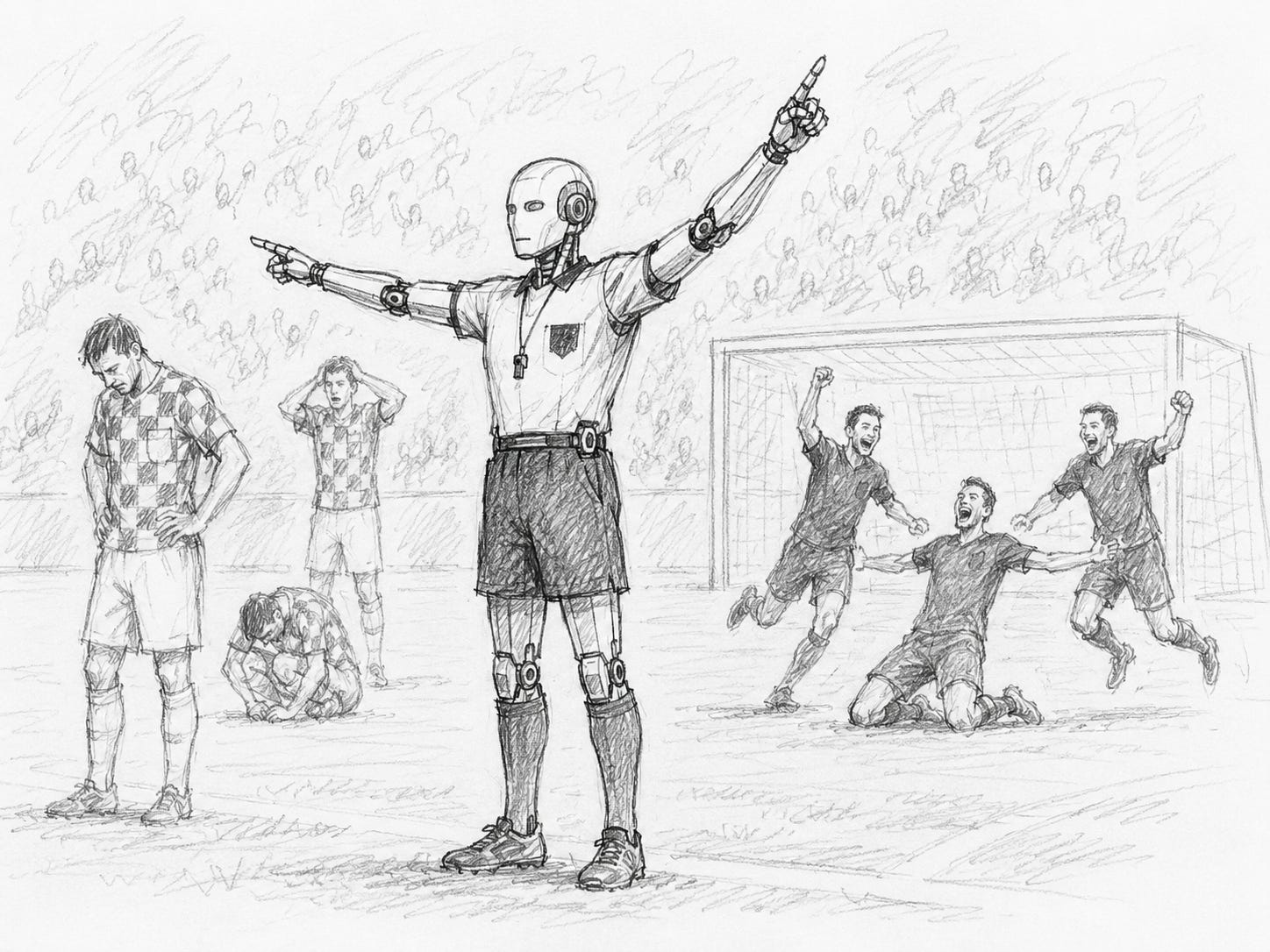
Automation Makes The World Cup Worse. But We Can’t Help Ourselves, Can We?
Advanced sensors and robot refs make the games more accurate and fair. But better? No, not at all.
An epic World Cup has been marred by an overreliance on technology and automation.
In this year’s competition, FIFA has used cameras, sensors, AI systems, and other automated tools to make the game more precise. But these tools, and the accompanying video assistant referee, have taken the soul out of the game.
FIFA’s tech tools have tipped the scales over touches and technicalities that would never be caught by the human eye, and exposed what’s lost when we hand too much to the machines. They’ve also revealed that even when automation noticeably degrades our products, we seem to be unable or unwilling to free ourselves from its grasp.
In soccer, or football as it’s known globally, consequential calls typically rely on human judgment and all the nuance, subjectivity, and context that come with it. An offside call, for instance, relies on the referee’s ability to notice a player making their way behind the defense before a pass heads their way. Video review can aid with that process on borderline calls, using a mix of AI, cameras, sensors, and other tech to theoretically make calls more accurate, more consistent, and protect against alleged bias. But the problem is the sport isn’t designed for this kind of microscopic precision, and relying on it degrades the game.
The worst-case scenario occurred in a July 2 match in which Croatia lost to Portugal. After Croatia scored what looked like the tying goal in stoppage time (aka: at the buzzer), sensors in FIFA’s connected ball detected it apparently grazed the tip of a Croatian player’s hair, leading to another player to be declared offsides while setting up the play, and the goal was then taken back.
Croatia’s hair graze didn’t register to the naked eye, or even on a big screen, but the reading from the sensor was enough for the human referee to let it change the game. The replay showed it as a “heartbeat graphic” spiking at the same moment it passed the player’s head.
“Technically correct,” wrote Roger Pielke Jr. of The Honest Broker in response to the robot call. “Good for the game? I think not.”
The latest flashpoint came ahead of tonight’s U.S.-Belgium match, after President Donald Trump reportedly urged FIFA to review the automatic one-match suspension for U.S. striker Folarin Balogun. FIFA suspended the ban while leaving the VAR-reviewed red card on his record, drawing objections from Belgium and a rebuke from UEFA.
The episode is a high-profile example of how technology can muck up a match. The referee did not initially show Balogun a red card, but a VAR review that slowed down the play made it appear to be a different kind of blow worthy of a send-off offense. While it might seem like a technicality, the example shows the difference between human and tech judgment: Protocol says slow motion can be used to establish factual issues such as point of contact, but normal speed should generally be used to judge the intensity of a foul.
Beyond the World Cup, there have been plenty of other recent examples of AI’s limitations across other industries. Last month, reports noted Ford has re-hired more than 300 veteran “gray beard” quality inspectors to help train younger staff and reprogram the car maker’s AI tools after its systems failed to match quality checks. And in May, Starbucks reportedly scrapped an AI program for automating inventory counts almost a year after it was deployed across North America. The cited AI error feels almost hilariously human: miscounting and mislabels items such as similar milk types.
From assisting refs to replacing other roles, time will tell if new tech will become a universal problem or just an isolated series of own-goals. But for now, it seems like we can’t help ourselves either way.
New Documentary: AI AGENTS How do we take back control? (sponsor)
AI agent security is one of the most important and most overlooked issues in technology right now. Organizations are deploying AI agents at speed, but many have no visibility into what those agents are doing, and few are accountable when something goes wrong.
I took part in "AI Agents: How Do We Take Back Control?," a documentary commissioned by Gravitee, where I interviewed researchers, policymakers, and enterprise leaders about how getting AI agent security right matters, not just for business but for society as a whole.
Some of the other tech in this year’s World Cup:
Here’s a brief look at some of the other tech FIFA is using this World Cup in partnership with various companies:
VAR is powered by tech provided by Hawk-Eye, which FIFA has been partnering with for years. While it was also used during the 2022 tournament, this year includes updates for computer vision systems which are using more cameras and that capture more skeletal points for each player than before.
Like in the last World Cup, matches again use a connected ball featuring a 500Hz motion sensor chip that detects every ball movement and helps referees make decisions in real time. Developed by Adidas, the ball also captures game highlights such as Messi’s hat trick against Algeria.
Lenovo’s partnership with FIFA is powering other tech including referee body cams, AI-stabilized footage and 3D avatars of 1,200+ players to give fans first-person views of games. Other data collected using Lenovo’s tech helps inform coaches, e-commerce systems and venue operations.
Hyundai and Boston Dynamics are working with FIFA to provide “Spot” robot dogs that patrol stadiums in Dallas and New Jersey for added security. The companies also just announced today that they’re bringing the Atlas humanoid robot to the Round of 16 to use in halftime activations. It was also used on Sunday to deliver the match ball during the Norway-Brazil match.
There are also reports of FIFA reportedly using biometric and surveillance tech, including anti-drone systems, to improve stadium security.
Google’s also working with Argentina’s national team, with Gemini being used to help analyze team plays, performance and stats. (That’s something other tech companies like IBM and Microsoft have been doing for years with other sports.)
The Intelligence Report
Google faced criticism for a new Independence Day commercial that imagines what it’d be like if the founding fathers had used AI to write the Declaration of Independence.
Anthropic redeployed its new Fable model to Claude after the U.S. government forced its suspension shortly after it debuted last month. It also announced a new AI workbench called “Claude Science.”
AWS said it’s investing $1 billion into a new AI unit focused on embedding engineers with customers. The move follows what other companies like OpenAI have also done recently, which resemble Palantir’s use of “forward-deployed engineers.”
OpenAI has reportedly proposed the U.S. Government on taking a 5% stake in the company, a pitch that reports say would involve other AI companies in the U.S. also giving the government a similar stake.
Nvidia said it’s partnering with AI cloud providers to expand compute access for startups, model builders, enterprises and researchers.
Meta is reportedly planning a new division called Meta Compute, which would allow it to create a cloud infrastructure business and sell compute to make money beyond advertising.
The latest on Big Technology Podcast: Who Wins The AI Superapp Battle?, Apple’s Consumer AI Victory, World Cup Automation Mistake
M.G. Siegler is the author of Spyglass.org. Siegler joins Big Technology to discuss the race to build the AI super app and which companies are best positioned to win. Tune in to hear why OpenAI, Anthropic, Google, Microsoft, Meta, and Apple are all converging on the same idea: an AI interface that can handle more and more of your computing life. We also cover Apple’s new Siri, whether consumer AI will be won by default on the iPhone, and what World Cup automation says about our growing reliance on machines. Hit play for a sharp, wide-ranging conversation about where AI products are headed next.
You can listen on Apple Podcasts, Spotify, or your podcast app of choice


