



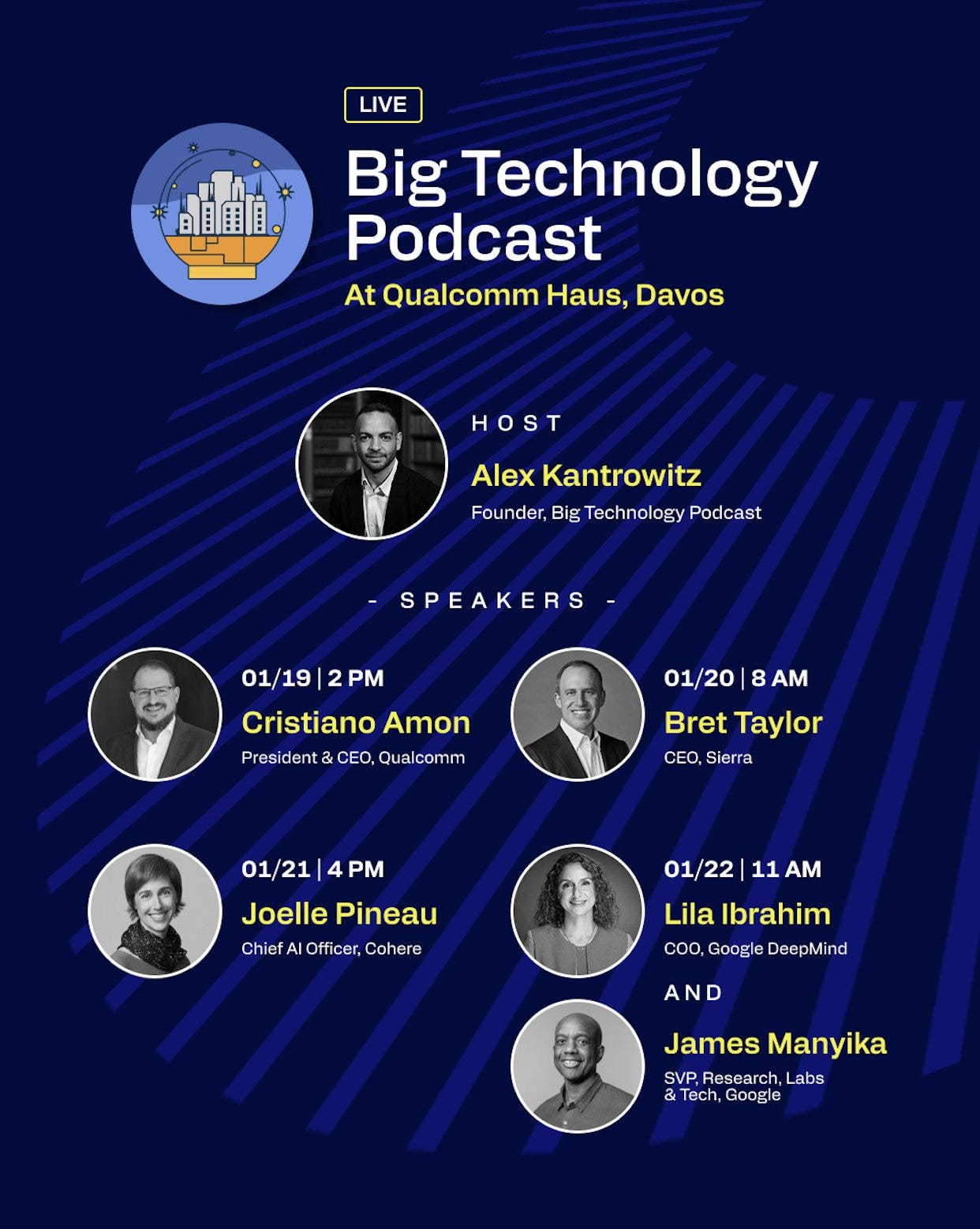
Good morning from Davos, Switzerland where I’ll be on the sidelines of the World Economic Forum conducting interviews with the globe’s AI leaders. You can expect Big Technology Podcast episodes this week with Google DeepMind CEO Demis Hassabis, Qualcomm CEO Christiano Amon, Cohere Chief AI Officer Joelle Pineau, Sierra CEO Bret Taylor, and more. Stay tuned for the full set of details below.
Already, you can tell this is going to be a weird WEF. The event has long been a place where the world’s businesses profess their interest in social good. But the message hasn’t been landing in recent years. Many firms have shed the do-good approach and more nakedly embraced the bottom line. And politics have followed a similar track (or led it, really) with self-interested policy winning over save-the-world platforms. With the pretense lifted, what is this annual gathering of Davos for?
One answer is artificial intelligence. AI will definitely be the new thing corporations talk about as they attempt to sell their altruistic side to the world. No less than 48 sessions over the five day WEF program will discuss AI, and the panels seem ready to position AI as the world best hope to cure cancer and empower the disempowered.
Walking the promenade, I’ve seen houses for Anthropic, Writer, Mistral, and more within a few minutes of where I’m staying. And I’m typing this in the shadow of a multi-story ‘AI house.’ Business will be done here, but perhaps more notably, AI’s Davos takeover is just another example of the technology’s broader envelopment of the business world and beyond.
A MESSAGE FROM OUR SPONSOR
Reshaping health care

At UnitedHealth Group, we’re reshaping care with a new approach: Helping physicians focus on patients and prevention, instead of paperwork.
See how we’re helping patients live healthier lives with a new model for health care.
Meet Marty Swant
Reporter Marty Swant is joining Big Technology as a contributor working on our new Agenda Setter emails, like this one. Swant is a veteran journalist with bylines at publications like the New York Times, Inc, and the Associated Press. We couldn’t be more thrilled to have him here!
Who’s Attending
Plenty of tech executives will be among the hundreds of global political and business leaders frolicking about Davos this week. The WEF expects record participation from governments, including 400 political leaders and 65 heads of state. Some of the biggest names in tech in business will make appearances for AI-related talks ranging from future of work and wages to creativity and ethics. Others will deal with darker realities like globalization, geopolitics, climate change, and the future of war.
Noteworthy names slated for the main program or various side events include Microsoft CEO Satya Nadella; Nvidia CEO Jensen Huang; OpenAI CFO Sarah Friar; Anthropic CEO Dario Amodei and Amazon CEO Andy Jassy. Others scheduled are Google DeepMind CEO Demis Hassabis; Palantir Technologies CEO Alex Karp; Mistral AI CEO Arthur Mensch; Sierra CEO Bret Taylor and Salesforce CEO Marc Benioff.
Some of the top executives flying in for the week will be speaking at various “houses” — branded chalets and hotels that countries and companies rent to host their own panels and dinners. Some houses will also be run by media companies including FT, Bloomberg, Axios and WSJ’s Journal House, which typically have more newsworthy discussions. Big Technology is partnering with Qualcomm for a set of live podcasts from the company’s house on the Promenade.
New this year: Nigeria House and Saudi Arabia’s first full pavilion signal new national ambitions in tech. The USA House, reportedly bankrolled by Microsoft and McKinsey helping sponsor $1 million each, hosts President Trump and cabinet members for four days on AI, digital assets, and defense.
Big Technology’s Davos Conversations
A preview of the week:
Monday: To kick things off, AI House will host a series of talks starting with a women’s AI breakfast, followed by talks about open-source AI, creativity, misinformation and human-centered intelligence. Another key topic during the week will be sovereign AI as countries make major investments in national LLMs and data centers. (KPMG is hosting a dinner about it on Tuesday and another discussion Thursday with the execs from CoreAI and SAP.)
Tuesday: Anthropic CEO Dario Amodei will be a featured speaker at WSJ’s Journal House for a talk about AI safety, job displacement and his company’s massive valuation. Other talks that same day in various locations will feature Arm CEO Rene Haas for a talk about the semiconductor market and a talk with Microsoft CEO Satya Nadella about how to responsibly deploy and scale AI. Crowdstrike will host a series of events throughout the week about AI and cybersecurity.
Wednesday: “Decade Déjà Vu: Are the 2020s the New 1920s?” with BlackRock CEO Larry Fink, ECB President Christine Lagarde, Citadel CEO Ken Griffin, and NYT Dealbook columnist Andrew Sorkin. Meanwhile, the Financial Times will host a conversation with Rishi Sunak, the UK’s former prime minister.
Thursday: AI’s impact on finance and the economy will be top of mind, including a talk about whether the middle class can be saved featuring Kentucky Governor Andy Beshear. Other featured events include a townhall about AI and ethics with Signal President Meredith Whittaker and MIT Professor Max Tegmark, a talk about defying cognitive atrophy with the Oxford’s chancellor, and an “honest conversation on AI and humanity” with Yuval Noah Harari.
Other example talks taking place:
“Dilemmas about Knowledge,” featuring the CEOs of Udemy and Cohere along with the vice chancellor of Cambridge.
“The Day After AGI,” with DeepMind Co-founder Demis Hassabis and Anthropic Co-Founder Dario Amodei.
Davos News So Far:
This week, more than two dozen top tech firms plan to formalize a commitment to broadening access to AI tools and support more than 120 million workers by 2030 through training and skills development.
A new WEF paper published this month offers a fresh look at how people are using AI for productivity, client interactions, and workflows.
Salesforce announced its Agentforce platform will be used to power an agentic tool called EVA, powered by WEF’s institutional knowledge, which will help Davos attendees access more information during the 2026 meeting.
WEF released its 2025-2026 global risks perception survey, which showed AI was the fifth highest concern people have over the next decade. The top four: extreme weather, biodiversity loss and ecosystem collapse, critical change to Earth’s systems and misinformation and disinformation.
Key Questions:
Can Davos continue to champion environmental sustainability while also supporting the acceleration of energy-hungry AI?
If “The Day After AGI” does arrive, who will govern it: governments, technologists, or whoever owns the compute?
Are political and business leaders at Davos there to benevolently shape AI’s future, or are they mostly there to make deals related to it?
None of these questions are new, but they feel unavoidable this week as Davos fills with talk of a more benevolent AI future. The real test is whether that rhetoric translates into action.

Thanks again for reading. Please share Big Technology if you like it!
Awesome to see the Marty / Big Tech collab!