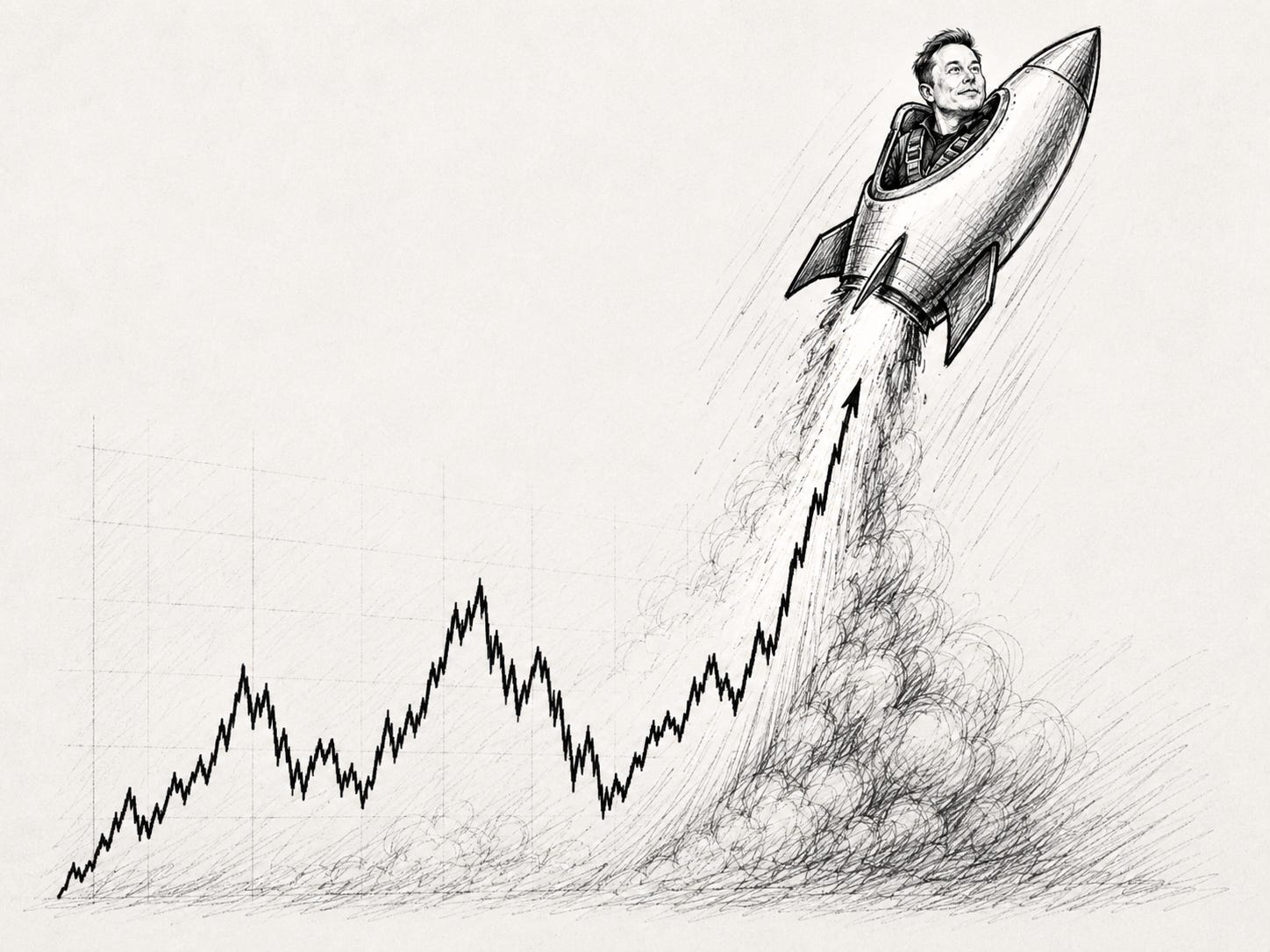
Elon Musk Sold Investors The Future. Now SpaceX Has To Build It.
SpaceX is trading up on its first full day on the public markets. Here's what it has to do to maintain the momentum.
On its first full day of trading, SpaceX is building on its massive IPO’s momentum. The company is up more than 14% on Monday, hitting a market cap above $2.4 trillion, which places it firmly within the ten largest companies in the world.
Now comes the hard part.
To maintain its momentum and lofty valuation, SpaceX will have to turn projections into real projects that attract real customers with real revenue. The company’s ambitions include lunar missions, a major enterprise AI business, renting massive compute, and someday launching data centers into orbit. But for now, it’s still a connectivity business with AI and rocket add-ons.
Looking forward, here’s what the company’s success will hinge on, from retail to the broader sentiment about AI:
Retail investors arrive onboard
SpaceX reportedly gave retail investors 20% of IPO shares, a higher percentage than the usual IPO range between 5% and 7%. That widened access, but it could also make SpaceX more volatile. For example, the company could experience sentiment-driven swings based on how shareholders feel about SpaceX’s moonshots or the AI trade more broadly. We’ll also soon see how much of the early enthusiasm around the company was FOMO versus a genuine belief in its business.
First AI company to launch
Because xAI sits under SpaceX, the IPO could influence the success of OpenAI and Anthropic’s own public offerings, or maybe even create a new reference point for investors. SpaceX, for its part, must follow through on plans that are more ambitious than OpenAI and Anthropic’s, such as its plan to launch space data centers. SpaceX’s IPO release also showed Anthropic agreed to pay it $1.25 billion a month for compute capacity through 2029, turning it into a neocloud of sorts. But there’s a caveat: Either party can cancel the deal with 90 days’ notice. A cancellation wouldn’t be great for the stock.
Into the AI money furnace
By folding xAI into its IPO, Elon Musk gave investors a first detailed look at the economics of a private AI lab. In some ways, the IPO could expose the cost of competing in frontier AI. SpaceX’s prospectus showed xAI spent $12.7 billion in capital expenditures in 2025, another $7.7 billion in the first quarter of this year and quarterly operating losses for xAI that rocketed from $936 million in Q1 2025 to $2.47 billion in Q1 2026. That could end up being a new kind of disclosure benchmark for cost and returns for Anthropic and OpenAI, whose eventual filings could be similarly be compared to xAI’s rather than just Microsoft, Meta, and Google.
Concentrated power
At SpaceX, nobody can outvote Musk. Post-IPO, he still owns about 82% of voting power. That’s power to choose most of SpaceX’s board, determine shareholder votes, take policy and business risks, and exert influence over major financial decisions.
Ripples in space
Beyond the AI market, it’s also possible SpaceX could help boost the broader space market. Over the weekend, The Wall Street Journal reported other venture-backed U.S. space-tech companies are experiencing more interest from potential investors. However, the report also noted smaller startups have a harder time being as resilient as giants like SpaceX. Even Jeff Bezos’s Blue Origin is in flux after its New Glenn rocket blew up last month.
A monthly outlook for leaders navigating what’s next (sponsor)
Welcome to Things to Know for TMT, where PwC shares the signals shaping technology, media and telecommunications—and the insights that can help you move forward. TMT companies are both building the AI economy and being transformed by it. In a market defined by constant change, TMT leaders need a clear view of what’s shifting, why it matters, and where to focus next. Each edition of this newsletter highlights the unique trends reshaping the industry, with practical insights to help your business respond with clarity and confidence. Not every signal will hit your agenda today. Focus on what moves your business forward.
The Intelligence Report
Anthropic released the Claude Fable 5 model, but was forced to suspend access days later after facing pressure from the U.S. government.
OpenAI confidentially filed for its IPO by submitting a draft of its S-1 to the SEC. Without providing a timeline, the company said it expects the draft to leak: “It may be a while because there are things we want to do that are likely easier as a private company.”
AI-pilled companies spend about $7,500 a month per employee, according to Ramp.
Three former DOGE employees and an outgoing pentagon CDO have a new AI defense startup focused on selling tech back to the government.
A German court based in Munich ruled that Google is liable when its AI Overviews generates false statements.
OpenAI is reportedly exploring if it should lower token prices in anticipation of a battle for users with Anthropic.
On Sunday, Stanford grads walked out of a commencement speech by Google CEO Sundar Pichai.
Meta is reportedly trying to cut down on employee AI costs as internal costs continue to climb.
KPMG reportedly published a report about successful enterprise AI that included hallucinated case studies.
Mastercard launched Agent Pay For Machines (AP4M), a new payment feature for AI agents with more than 30 initial partners including Cloudflare and various crypto companies, banks and payment providers.
Runway’s Big Week: AI Film Festival, Ron Howard, and Lionsgate Expansion
A few years ago, it would’ve been hard to imagine 1,000 people showing up to see a bunch of AI-generated short films or to believe a legendary filmmaker like Ron Howard would be on stage to kick things off.
Both happened last week in New York City for the fourth annual Runway AI Film Festival, which featured nearly a dozen AI films across a range of genres chosen from what Runway — an AI video generation company — said was thousands of submissions from around the world.
Runway also announced an expanded partnership with Lionsgate that includes Lionsgate taking an equity interest in Runway and a new joint development program, starting with a short-form episode series based on Lionsgate’s existing IP. The deal builds on the companies’ 2024 deal focused on training a new AI video model customized on Lionsgate’s catalog.
Before the screening, Ron Howard joined Runway CEO Cristóbal Valenzuela for a conversation about AI and the future of filmmaking. Howard said there’s a lot to still figure out with AI, including copyright issues and other ethical questions, but storytelling matters most.
Recalling when he switched from physical film editing to the Avid Media Composer, one of the first digital editing systems that debuted in 1989, Howard said AI is just another example of a long line of tools that have transformed filmmaking.
“What’s worth our time? What are we invested in? What values do we care about?” Howard said. “Do we care about knowing the alive actors on screen and connecting with them for that reason, which I think won’t ever go away. But are we also fully linked to investing in characters that are synthetic? There are already CGI characters.”
At a small press conference before the screening, Valenzuela also spoke with journalists about a range of issues and trends in AI. Below is a sample of the points he made:
On AI costs: Valenzuela pushed back on the idea that AI video will face the same runaway cost problem as agents and LLMs. He thinks the cost of media generation will fall the same way film and photo development costs did, arguing that video generation is usage-based and time-bounded without the same risks of leaving a model running for hours chasing an answer: “The [creative] process is the answer itself.”
On Sora shutting down: When asked what OpenAI shutting Sora means for AI video, Valenzuela said it made Runway’s own competitive thesis even clearer: “You can’t just be doing 15 things.” Valenzuela said companies are starting to realize that trying to do video alongside other efforts costs attention and prioritization: “They’re also trying to do many other things, and I think my assumption is it’s not going to work unless we’re fully focusing.”
On AI film quality and style: Valenzuela said AI video models weren’t able to emulate realism as recently as a year ago, but that’s now changing. He also noted filmmakers are splitting into camps with some chasing photorealism and others deliberately moving away from it to find something more raw or more strange. The way Valenzuela put it, the exploration of styles and processes is “the artist is just trying to find a new grammar.”


