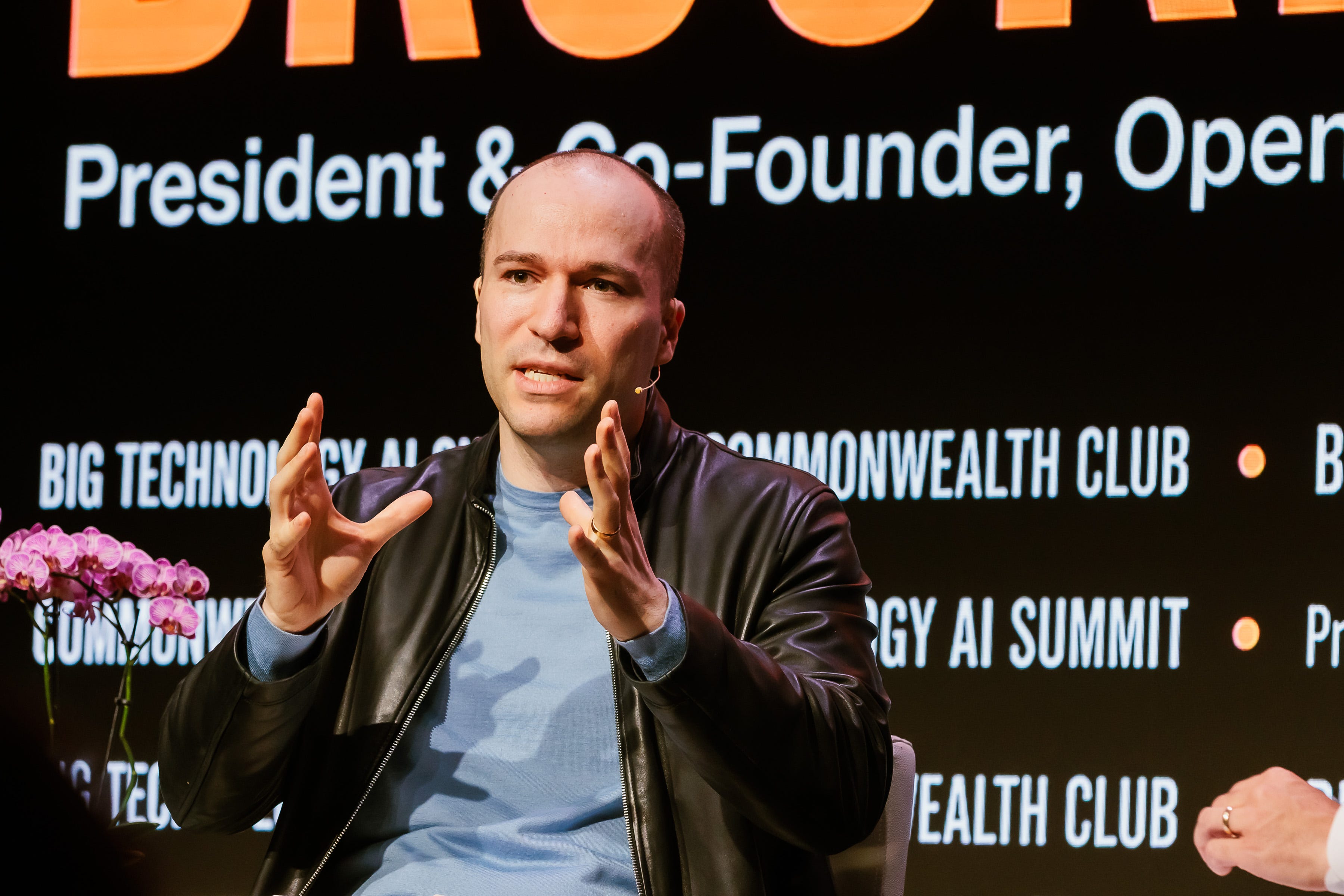
Greg Brockman On OpenAI’s Plan To Win: Compute Rules All
Appearing at the Big Technology AI Summit Thursday, OpenAI president Greg Brockman indicated that winning the compute race could be the key to winning more broadly.
If AI model capabilities continue to improve fast — and relatively in sync across frontier labs — the lab with the most compute will win in the end, OpenAI president Greg Brockman suggested at the Big Technology AI Summit on Thursday.
“There just is not going to be enough compute in the world to satisfy all the demand,” Brockman said. “Right now, we’re talking about compute constraints and the number of people using these agents is — the order of 10 million, 20 million maybe — we’re not at planet scale.”
“ChatGPT is like a billion users,” Brockman continued, “but we haven’t brought the agentic power there yet, so you’re just looking at these factors and the depth of usage is also tiny compared to where we’re going.”
Brockman’s view explains why OpenAI has been investing so heavily in its datacenter buildout. The company is engaged in a historic investment in compute. It raised $122 billion earlier this year, and much of it will go towards building the infrastructure needed to serve these use cases. Competitors have chided the company for its spending — Anthropic CEO Dario Amodei called it “YOLOing” — but for Brockman, the buildout is a core element of how OpenAI plans to win over time.
At the summit, Brockman also outlined OpenAI’s vision for an AI product experience where the bots take action for you, noting platforms like Codex are catching on even with people doing non-software work. The way he sees it, the right form factor and the right capabilities have to match up to get the most out of AI models, adding that the best way to interact with a computer might be to talk with it verbally instead of typing everything.
“The beautiful thing about AI is it’s really about bringing the machine closer to the human,” Brockman said. “Rather than us having to contort ourselves to find files, folders, and all these details that somehow are not natural, that are more about how the machine operates rather than how we operate.”
Brockman also downplayed speculation of a potential price war with competitors, saying only that pricing will keep going down in the long term even without expecting a “massive shift in the short term.” He thinks frontier intelligence will always remain the most expensive tier.
“The most important thing that is happening right now is the usage of AI in the economy to really transform the economy and to uplift everyone,” Brockman said. “And so I think that is something I’m really focused on. And the more that people are trying to make that happen, I think that that’s better for everyone.”
Other highlights from yesterday’s AI Summit below…
A monthly outlook for leaders navigating what’s next (sponsor)
Welcome to Things to Know for TMT, where PwC shares the signals shaping technology, media and telecommunications—and the insights that can help you move forward. TMT companies are both building the AI economy and being transformed by it. In a market defined by constant change, TMT leaders need a clear view of what’s shifting, why it matters, and where to focus next. Each edition of this newsletter highlights the unique trends reshaping the industry, with practical insights to help your business respond with clarity and confidence. Not every signal will hit your agenda today. Focus on what moves your business forward.
Mike Krieger and the fate of Fable
Anthropic Head of Labs Mike Krieger isn’t sure what will happen to Fable 5 or why it’s been singled out by the U.S. government. But the Instagram co-founder joked that users’ pleas for its return reminds him of the uproar when Instagram removed its Gotham filter. On stage, Krieger shared how his team thinks about projects and products, including visualizing the gap between what models can do now and designing products for capabilities likely to emerge six months from now. He also shared examples of how he’s used Fable and what sets it apart by understanding a “theory of the project,” such as converting hundreds of thousands of lines of code in about an hour when he thought it’d take all night.
Aaron Levie, Co-founder and CEO of Box
Aaron Levie, Box’s co-founder and CEO, spoke on stage about the geopolitics of sovereign AI and what it means for export control, regulations, innovation and the overall AI race. As open-weight models from China and other countries (like Mistral in France) close the gap with closed frontier models, Levie thinks the value could shift to the applied layer that many thought would just be a wrapper. (That could be a good thing for enterprise companies like Box, Cursor, Harvey and others.) He predicts companies will reserve the most powerful and expensive AI models for managing and reviewing work rather than performing most of it, creating a barbell-shaped architecture.
“We’re outrunning the efficiency improvements in our appetite for what these models can go and do,” Levie said. “What you need to do is have a way to normalize the cost of the tokens to the tasks that you can now deploy.”
Alex Stamos on the the U.S. government’s “own goal” with AI
Alex Stamos, Chief Product Officer of Corridor, thinks the U.S. government’s decision to abruptly shut down Fable was a “massive own goal” at a moment when there’s increased pressure from China. One of the 150 security experts who signed an open letter last week criticizing the government’s restrictions, Stamos — who was Facebook’s former chief security officer during the Cambridge Analytica crisis and 2016 election — warned the policies could weaken American models’ ability to write secure software and could even push American companies toward cheaper Chinese alternatives. He also suggested Anthropic and others might want to consider redefining “jailbreak” and having different levels of cyber capabilities and risks, adding that frontier systems are already “superhuman bug finders,” adding that the teams are drowning in bugs because they’re becoming so common.
“If you’re a pedestrian and you get hit by an F-150 at 80 miles per hour or a McLaren at 200 miles per hour, you don’t really care,” Stamos said. “You’re dead.”


