Heavy AI Adoption Linked To More Hiring, Not Layoffs, New Data Shows
A new Ramp study shows that the companies spending the most on AI are actually hiring more and not cutting the workforce.
There’s a flawed yet oft-repeated narrative that AI adoption in the workplace will inevitably lead to layoffs and job loss. The narrative’s been propagated by some of the most visible leaders in tech, including Anthropic CEO Dario Amodei and Block CEO Jack Dorsey, the latter of whom used AI as a rationale for laying off 40% of his staff.
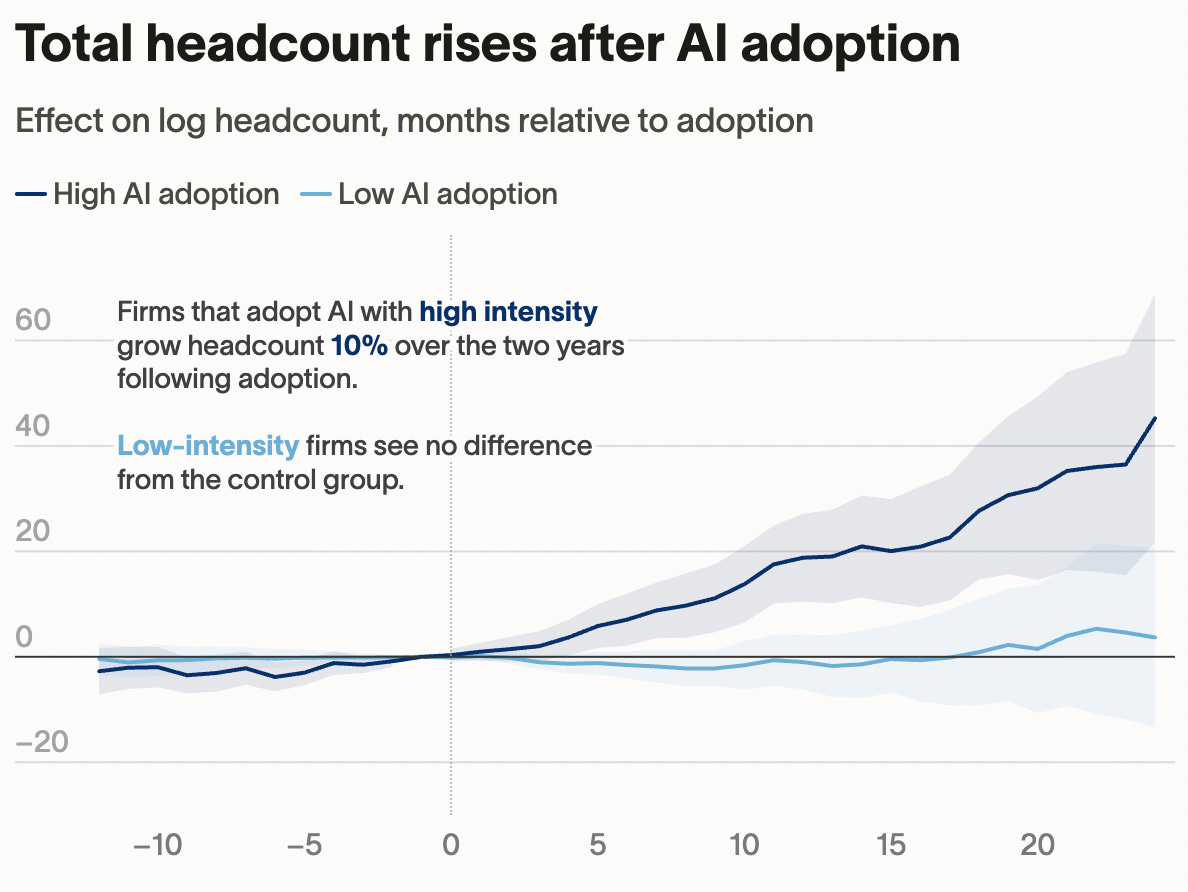
But a new study from Ramp and Revelio Labs finds the opposite: The most enthusiastic adopters of AI are actually adding employees, not subtracting them.
“In a sample covering more than 21,000 U.S. firms,” Ramp lead economist Ara Kharazian wrote on Tuesday, “We find that companies that invest heavily in AI grow headcount 10% over the two years following adoption. Entry-level headcount grows 12%.”
The study, coming nearly four years after OpenAI released ChatGPT, should cool down some of the inflammatory rhetoric about AI and job loss, or at least contextualize it. To date, there’s been no sign of widespread job loss despite the availability of AI tools that can do human work. That could change as the technology gets stronger, but there’s little indication that today’s AI tools are job takers vs. job makers.
The benefits of using AI don’t seem to accrue right away, per the study. “The earliest signs of growth emerge roughly 6-12 months after adoption,” it found. “Perhaps after firms establish best practices, integrate AI tools into workflows, and are subsequently able to make new investments and hire staff.”
To be sure, there are some important caveats here. Overall AI investment across the companies studied is still quite small, with the heavy adopters spending $33.67 per employee per month on average. And many of the firms using AI and hiring are startups or venture-backed companies that have an imperative to grow. “Adopters are more technical, higher-paying, and more likely to be venture-backed,” the study said.
Still, for those seeking to categorically link AI adoption with job loss, the early data seems to be making the opposite case.
More: Listen to Ramp lead economist Ara Kharazian discuss what the company’s latest data says about AI adoption on Big Technology Podcast.
New Documentary: AI AGENTS How do we take back control? (sponsor)
AI agent security is one of the most important and most overlooked issues in technology right now. Organizations are deploying AI agents at speed, but many have no visibility into what those agents are doing, and few are accountable when something goes wrong.
I took part in "AI Agents: How Do We Take Back Control?," a documentary commissioned by Gravitee, where I interviewed researchers, policymakers, and enterprise leaders about how getting AI agent security right matters, not just for business but for society as a whole.
The latest on Big Technology Podcast: Anthropic’s Mythos is Back, OpenAI Releases GPT 5.6, Apple’s Price Increases
Ranjan Roy from Margins is back for our weekly discussion of the latest tech news. We cover: 1) Mythos is back 2) OpenAI releases GPT-5.6 to a small group 3) Should the government pick winners? 4) Is this a blessing to open source AI? 5) Is the gating of frontier models bad for these companies businesses? 6) Frontier lab customers are finding cheaper ways to do business 7) There’s a bunch of overbilling happening in opaque AI systems 8) Is SpaceX’s valuation frothy? 9) Apple’s price raises: Greed or not? 10) Apple’s impact on the memory space 11) Rest in peace, Om Malik
You can listen on Apple Podcasts, Spotify, or your podcast app of choice


