

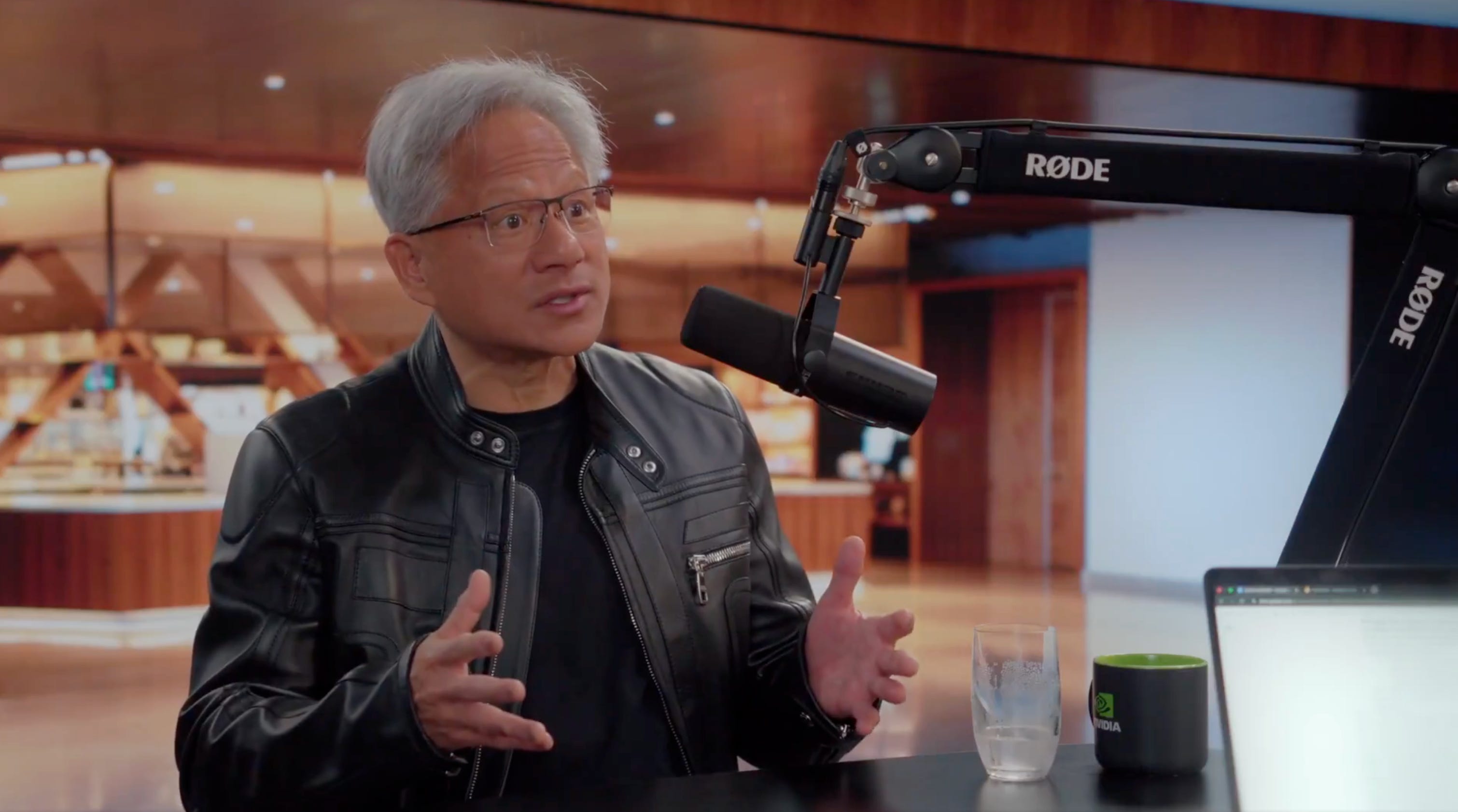
Jensen Huang, master of media, didn’t have it this time. The Nvidia CEO stumbled in an interview with podcaster Dwarkesh Patel this week, losing his calm veneer — while issuing an instant-classic “I didn’t wake up a loser” quote — and struggling to make satisfying arguments on his company’s two most critical issues.
Huang’s built Nvidia into the world’s largest company by making its technology essential to AI computing, but when pressed about competition and restrictions on selling into China, his answers fell flat. Nvidia stock didn’t flinch following the conversation (demand for its technology remains insatiable) but Huang’s responses didn’t exactly slam the door shut on its long-term challenges either.
Nvidia’s biggest threat today is well-funded competitors creating purpose-built AI chips that do a good enough job training and running AI models. Google’s Gemini and Anthropic’s family of models, including the latter’s Mythos, have been built outside of Nvidia’s ecosystem, a counterweight to Nvidia’s dominance. In the interview, Huang spelled out that Mythos, a model reportedly so powerful Anthropic won’t release it to the public, was built on basic computing hardware.
“Mythos was trained on fairly mundane capacity,” Huang said. “And a fairly mundane amount of it.”
Huang’s Mythos reference was meant to illustrate that China could build strong AI models without Nvidia technology (more on that shortly) yet highlighted that Nvidia isn’t a necessary component in frontier AI models today. If Anthropic could build Mythos on “mundane capacity,” then perhaps Nvidia isn’t a must-have for its counterparts.
Anthropic, to be sure, has struggled to meet demand using its current compute architecture. Its users often complain about Claude’s rate limits. And, per Huang, it’s almost solely responsible for Nvidia’s competitors’ growth. “Anthropic is a unique instance, not a trend,” Huang said. “Without Anthropic, why would there be any TPU growth at all? It’s 100% Anthropic. Without Anthropic, why would there be Trainium growth at all? It’s 100% Anthropic.”
Still, of the top three AI labs in the world, as Patel noted, only OpenAI is reliant on Nvidia’s GPUs. Meta and Grok, which have made massive GPU investments, aren’t faring as well as hoped. This doesn’t mean Nvidia is cooked, but it could cut into growth over time. And Huang was uncharacteristically flat-footed on that line of questioning.
The China Question
Export restrictions on sales to China is another meaningful threat that looms over Nvidia’s business, but Huang didn’t persuasively argue against them either. He simply refused to entertain the possibility that selling more powerful chips to China could enhance that country’s offensive cyberwarfare capabilities.
Asked repeatedly whether he would acknowledge the potential threat that could result from giving China more powerful chips, Huang evaded time and again. “I just want you to acknowledge that any marginal sales for the American technology industry is beneficial,” Huang retorted in one exchange.
Huang isn’t in the easiest position in these interviews. He must balance his relationship with the U.S. government, China’s leadership, his employees, the public, and shareholders. This may have hamstrung him from making the strongest case against export controls. That is: Exporting Nvidia’s technology worldwide means there’s a better chance American values will be baked into LLMs and their applications moving forward. Huang probably couldn’t say that outright, out of concern for China’s reaction. But he did hint at it in the strongest part of the interview.
“We get the benefit of American technology leadership,” Huang said of dropping export controls. “We get the benefit of developers working on the American tech stack. We get the benefit, as those AI models diffuse out into the rest of the world, that the American tech stack is therefore the best for it. We can continue to advance and diffuse American technology. That, I believe, is a positive.”
Huang’s interview has been something of a Rorschach test in the tech industry since its release. For some, he valiantly made the case for Nvidia against an unnecessarily adversarial interviewer. For others, he alarmingly lost his composure in the face of standard, informed questioning. The truth is probably somewhere in the middle: Nvidia remains a dominant, key driver (and beneficiary) of the AI boom. It’s also not invincible. No company is.
An Autonomous AI Assistant for Everyone (sponsor)

You don’t need another productivity “hack.” You need real help you can deploy today.
Use Wingman, the fully-customizable AI agent that works where you do.
Wingman handles low-stakes tasks (social media, emails, research, ops) without monitoring, so you can focus on other priorities.
Works inside WhatsApp, Telegram, iMessage, Gmail, etc
Build one in 5 minutes (no coding or experience needed)
Requires confirmation for anything consequential or sensitive
It’s private, secure, and designed to act with your permission.
Advertise with Big Technology?
Reach 150,000+ plugged-in tech readers with your company’s latest campaign, product, or thought leadership. To learn more, write alex@bigtechnology.com or reply to this email.
What Else I’m Reading, Etc.
Anthropic asks religious leaders if Claude can be a “child of God” [Washington Post]
Dario Amodei is heading into the White House for peace talks [Axios]
Allbirds, somehow, is a GPU company now? [Bloomberg]
Google’s AI mode comes to Chrome [Techcrunch]
SantaCon leader accused of conning the santas [New York Times]
This Week On Big Technology Podcast: The Pentagon’s AI Plan + Behind the Anthropic Fight — With Under Secretary of War Emil Michael

Emil Michael is the Under Secretary of War for Research and Engineering at the Pentagon. Michael joins Big Technology to discuss how AI is transforming the Department of War, from targeting systems to drone warfare to cyber defense. Tune in to hear his account of why the Pentagon designated Anthropic a supply chain risk, what actually happened in the contract negotiations, and whether the decision was wise. We also cover how the military’s Maven Smart System works in practice, what the U.S. learned from drone warfare in Ukraine and Iran, and whether the Pentagon Pizza Index is credible. Hit play for one of the most candid conversations you’ll hear about AI and national security.
You can listen on Apple Podcasts, Spotify, or your podcast app of choice
Thanks again for reading. Please share Big Technology if you like it!
And hit that Like Button, you didn’t wake up a loser after all
My book Always Day One digs into the tech giants’ inner workings, focusing on automation and culture. I’d be thrilled if you’d give it a read. You can find it here.
Join Big Technology’s Private Discord Server!
Where we’ll talk about this story, the latest in AI, the week’s podcast, and plenty more. You can sign up via the link below: