

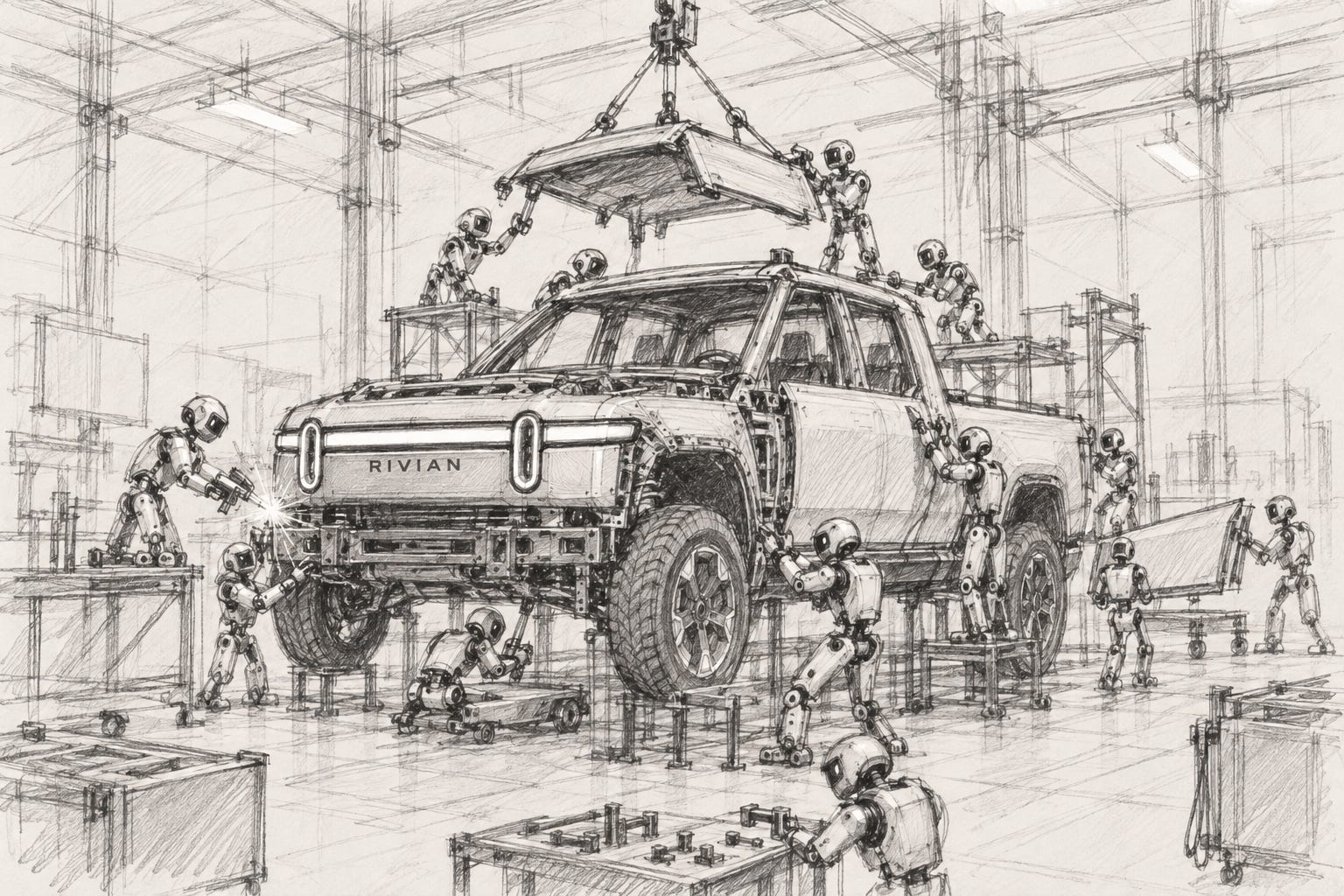
Rivian CEO RJ Scaringe is behind the wheel of a fully-loaded R1 SUV, plodding through traffic on a dreary Wednesday New York City afternoon, when he tells me people are underestimating the progress in robotics today.
“The rate of progress in robotics is going to be far higher than the world knows,” he says. “Far, far, far, far faster.”
Scaringe, the 43-year-old CEO of the $18 billion electric car company, founded Mind Robotics, a new robotics company, in 2025, raising $1 billion with a plan to take advantage of the field’s latest advances. The company is building industrial robots that are not quite humanoids, but have two arms, two hands, fingers that splay wider than human digits, and fingernails that can be used to manipulate thin items that require a light touch.
Scaringe and I met at Rivian’s showroom on 14th street in New York City this week. And after some schedule jenga, he offered me a ride my podcast studio across town so we could have the maximum amount of time to talk. Expecting a cursory update on a car company, I left with at least some belief that the so-called ‘ChatGPT moment for robotics’ might arrive sooner than anticipated.
The key development, Scaringe tells me, is that robots are now starting to learn broad, generalizable skills, unlike their predecessors that moved with prescribed motions, and that is unlocking an array of new possibilities. The transformer model at the heart of LLM technology is also being used to enable these advances as well. “This is a transformer-based model,” Scaringe says. “We’re using transformers to take really complex, diverse sets of data, convert that into models with weights, use those models with weights to drive action.”
Instead of telling a robot the exact movements it needs to make to clean a surface, for example, Scaringe says you’re starting to be able to just tell it to clean a surface and its internal model will be able to use generalized motion skills to figure it out. Look at a phone, and it will use its fingers to pick it up. Look at a credit card, and it will use fingernails.
Scaringe, who can’t escape being measured up to Elon Musk as a head of an electric car company, is now competing with Musk in robotics as well. Scaringe’s robots are, in a sense, the anti-Optimus. As opposed to Musk’s general purpose humanoids, Scaringe’s bots are factory-centric and meant to be sold to manufacturers. This is because Scaringe belives the economics are better his way.
“You need to have a business that’s willing to pay for the robot,” he says. “Would you be willing to pay a robot $10,000 a year to fold your laundry? Maybe, but that’s a small selection. But would you be willing to have a robot that you paid $50,000 a year to work three shifts in a manufacturing plant? Absolutely.”
Indeed, Mind Robotics has a deal with Rivian where it trains and runs its latest technology. Within Rivian’s plants, workers wear cameras to feed data about their movements to the robots’ AI models, and they have cameras watching their movements, feeding the data to the models as well. In a sense, it’s modern-day Taylorism, a practice where factory managers watched workers in the industrial age, identified all unnecessary movement, and asked workers to move in regimented motions. This time though, it will be the robots doing the efficient work.
Scaringe believes that a wide spectrum of industrial work will be automateable, including an entire factory. “Take a Rivian plant, we have 6,000 robots today, we have 7,000 people,” Scaringe says. “All those jobs that people are doing are things that more advanced robotics could do.”
But what of the workers?
“I think robotics is going to be like multi-decade transition,” Scaringe says, explaining that the complexity of industrial work will necessitate longer-time-horizon rollouts vs. immediate adoption.
Still, he’s under no illusion that the future of human labor will look anything like it does today. “Now it’s pretty rare that you meet a farmer,” he says. “But if this was 125 years ago, that would have been normal. I think the same is going to play out in not just manufacturing, but lots of different segments where the things we’ve done historically are going to start to shift.”
How $31 Trillion In Datacenters Get Built By 2050 — With Dallas Dolen (sponsor)

Dallas Dolen is the TMT leader at PwC. Dolen joins Big Technology to discuss PwC’s projection that global AI infrastructure investment could reach $31 trillion through 2050. Tune in to hear why he believes surging compute demand can outrun efficiency gains, and how the world could generate enough power to support the buildout. We also cover international competition for data centers, growing political opposition, AI’s consumer opportunity, and whether today’s models are already powerful enough to transform business. Hit play for a wide-ranging look at what it will actually take to build the infrastructure behind the AI boom.
This Week On Big Technology Podcast: The Bumpy Road To AGI — With Kevin Roose

Kevin Roose is the author of The AGI Chronicles,. Roose joins Big Technology Podcast to discuss whether an AI industry rife with personal rivalries, infighting, and mistrust can be trusted to develop technology more powerful than humans. Tune in to hear why Roose emerged from years of reporting inside OpenAI, Anthropic, and Google DeepMind more concerned about AI safety, why he believes the industry should slow down, and what happens if AI systems begin improving themselves. We also cover Sam Altman’s leadership style, Dario Amodei’s motivations, Sergey Brin’s return to Google, Microsoft’s AI missteps, and the behind-the-scenes drama of OpenAI’s boardroom coup. Hit play for an inside look at the personalities, power struggles, and technological breakthroughs shaping the race to superintelligence.
You can listen on Apple Podcasts, Spotify, or your podcast app of choice
Thanks again for reading. Please share Big Technology if you like it!
And hit that Like Button or a robot might do it for you
My book Always Day One digs into the tech giants’ inner workings, focusing on automation and culture. I’d be thrilled if you’d give it a read. You can find it here.
Join Big Technology’s Private Discord Server!
Where we’ll talk about this story, the latest in AI, the week’s podcast, and plenty more. You can sign up via the link below: