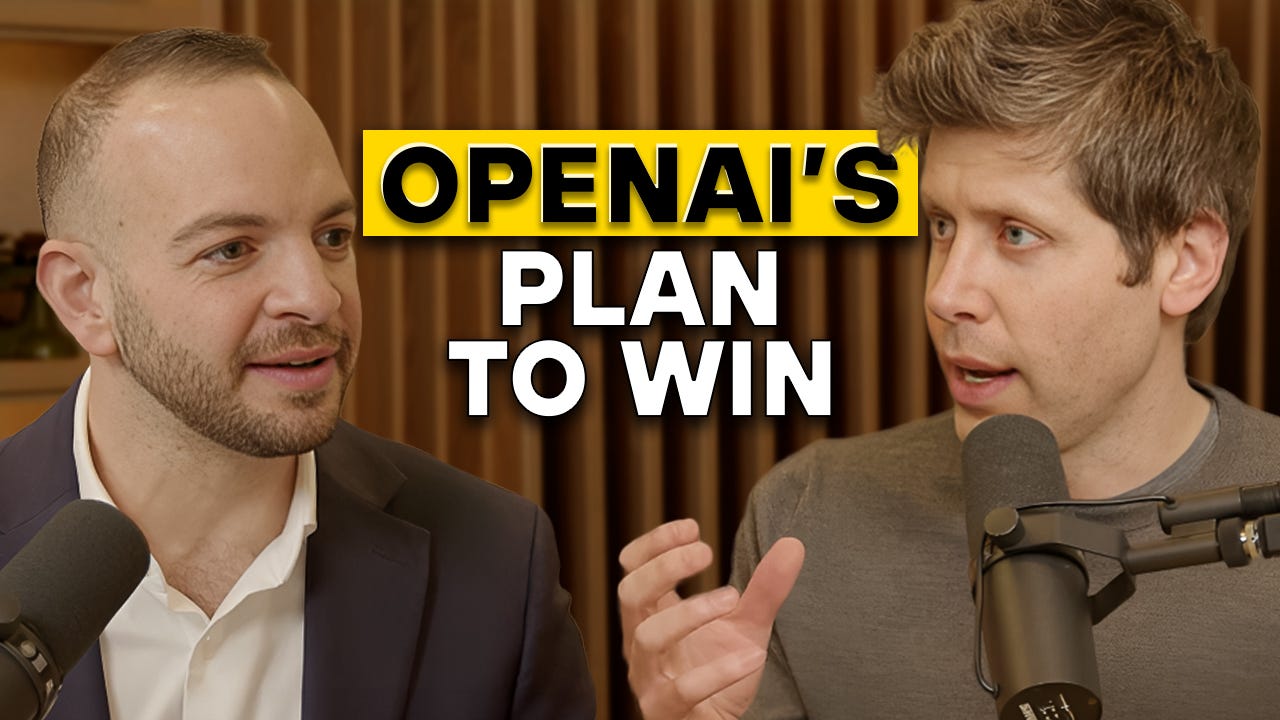
Sam Altman on OpenAI’s Plan to Win, AI Personalization, Infrastructure Math, and The Inevitable IPO
OpenAI's CEO joins Big Technology for a candid discussion covering OpenAI's strategy, its product ambitions, its ability to pay for $1 trillion+ in infrastructure, going public, and much more.
When Sam Altman walks into the studio at OpenAI’s San Francisco headquarters on Tuesday, the building is in a heightened state of alert. Google’s impressive Gemini 3 model has sent OpenAI into a ‘Code Red’ and concerns about the increasingly turbulent AI infrastructure buildout are mounting.
Amid it all, Altman comes in ready to address OpenAI’s strategy to win, where he expects his product lineup to go in the coming year, how his company’s $1 trillion+ in AI infrastructure commitments make sense, and his future plans for AI devices and AI cloud.
Altman — in a conversation we’re airing on Big Technology Podcast and publishing in full here — outlined a clear strategy to keep OpenAI ahead: Get people to use its products, keep them there with the best models, and serve the use cases they want with reliable compute. Then, expand into areas like enterprise and hardware.
Here’s our full conversation, edited lightly for length and clarity. You can also listen/watch, on Apple Podcasts, Spotify, or YouTube.
Alex Kantrowitz: OpenAI is 10 years old and ChatGPT is three, but the competition is intensifying. OpenAI headquarters is in a Code Red after Gemini 3’s release. And for the first time I can remember, it doesn’t seem like this company has a clear lead. How will OpenAI emerge from this moment, and when?
Sam Altman: First of all, on the code red point—we view those as relatively low stakes, somewhat frequent things to do. I think that it’s good to be paranoid and act quickly when a potential competitive threat emerges. This happened to us in the past. That happened earlier this year with DeepSeek. And there was a code red back then too.
There’s a saying about pandemics, which is something like when a pandemic starts, every bit of action you take at the beginning is worth much more than action you take later, and most people don’t do enough early on and then panic later—and we certainly saw that during the COVID pandemic. But I sort of think of that philosophy as how we respond to competitive threats.
Gemini 3 has not, or at least has not so far, had the impact we were worried it might. But it did, in the same way that DeepSeek did, identify some weaknesses in our product offering strategy, and we’re addressing those very quickly. I don’t think we’ll be in this code red that much longer. These are historically kind of like six or eight week things for us, but I’m glad we’re doing it.
We just launched a new image model, which is a great thing that many consumers really wanted. Last week we launched GPT 5.2, which is going over extremely well and growing very quickly. We’ll have a few other things to launch, and then we’ll also have some continuous improvements, like speeding up the service.
My guess is we’ll be doing these once, maybe twice a year, for a long time, and that’s part of really just making sure that we win in our space. A lot of other companies will do great too, and I’m happy for them. But ChatGPT is still, by far, by far the dominant chatbot in the market, and I expect that lead to increase, not decrease over time.
The models will get good everywhere. But a lot of the reasons that people use a product, consumer or enterprise, have much more to do than just with the model. And we’ve been expecting this for a while, so we try to build the whole cohesive set of things that it takes to make sure that we are the product that people most want to use.
I think competition is good. It pushes us to be better. But I think we’ll do great in chat. I think we’ll do great in enterprise. In the future years, other new categories, I expect we’ll do great there too. I think people really want to use one AI platform. People use their phone in their personal life, and they want to use the same kind of phone at work. Most of the time. We’re seeing the same thing with AI. The strength of ChatGPT consumer is really helping us win the enterprise.
Of course, enterprises need different offerings, but people think, “Okay, I know this company OpenAI and how to use this ChatGPT interface.” So the strategy is: make the best models, build the best product around it, and have enough infrastructure to serve it at scale.
ChatGPT, earlier this year, was around 400 million weekly active users. Now it’s at 800 million. But then on the other side, you have distribution advantages at places like Google. Do you think the models are going to commoditize? And if they do, what matters most? Is it distribution? Is it how well you build your applications? Is it something else?
I don’t think commoditization is quite the right framework to think about the models. There will be areas where different models excel at different things. For the kind of normal use cases of chatting with a model, maybe there will be a lot of great options. For scientific discovery, you will want the thing that’s right at the edge that is optimized for science, perhaps. So models will have different strengths, and the most economic value, I think, will be created by models at the frontier.
And we plan to be ahead there. We’re very proud that 5.2 is the best reasoning model in the world and the one that scientists are having the most progress with. But also we’re very proud that it’s what enterprises are saying is the best at all the tasks that a business needs to do its work. So there will be times that we’re ahead in some areas and behind in others, but the overall most intelligent model, I expect to have significant value.
Even in a world where free models can do a lot of the stuff that people need, the products will really matter. Distribution and brand, as you said, will really matter. In ChatGPT, for example, personalization is extremely sticky. People love the fact that the model gets to know them over time, and you’ll see us push on that much, much more.
People have experiences with these models that they then really kind of associate with it. And I remember someone telling me once, like, you kind of pick a toothpaste once in your life and buy it forever. Or most people do that, apparently. And people talk about it—they have one magical experience with ChatGPT. Healthcare is like a famous example where people put their blood test into ChatGPT or put these symptoms in, and they figure out they have something, and they go to a doctor and they get cured of something they couldn’t figure out before. Those users are very sticky, to say nothing of the personalization on top of it.
There will be all the product stuff. We just launched our browser recently, and I think that’s pointing at a new, pretty good potential moat for us. The devices are further off, but I’m very excited to do that.
So I think there will be all these pieces. And on the enterprise, what creates the moat or the competitive advantage? I expect it to be a little bit different. But in the same way that personalization to a user is very important in consumer, there will be a similar concept of personalization to an enterprise, where a company will have a relationship with a company like ours, and they will connect their data to that, and you’ll be able to use a bunch of agents from different companies running that, and it’ll kind of make sure that information is handled the right way. And I expect that’ll be pretty sticky too.
I know you think of us largely as a consumer company, but we have more than a million enterprise users, and we have absolutely rapid adoption of the API. The API business grew faster for us this year than even ChatGPT. So the enterprise stuff is really happening starting this year.
If commoditization is not the right word, maybe it’s model parity for everyday users. When it comes to ChatGPT’s ability to grow, if I’ll just use Google as an example, if ChatGPT and Gemini are built on a model that feels similar for everyday uses, how big of a threat is the fact that Google has all these services through which it can push out Gemini, whereas ChatGPT is fighting for every new user?
I think Google is still a huge threat. Extremely powerful company. If Google had really decided to take us seriously in 2023, let’s say, we would have been in a really bad place. I think they would have just been able to smash us, but their AI effort at the time was kind of going in not quite the right direction. Product-wise, they didn’t—you know, they had their own code red at one point, but they didn’t take it that seriously.
Also, Google has probably the greatest business model in the whole tech industry, and I think they will be slow to give that up. But bolting AI into web search—I don’t know, maybe I’m wrong, maybe I’m drinking the Kool-Aid here—I don’t think that’ll work as well as reimagining the whole thing.
This is actually a broader trend I think is interesting. Bolting AI onto the existing way of doing things, I don’t think is going to work as well as redesigning stuff in this sort of AI-first world. It’s part of why we wanted to do the consumer devices in the first place, but it applies at many other levels.
If you stick AI into a messaging app that’s doing a nice job summarizing your messages and drafting responses for you, that is definitely a little better. But I don’t think that’s the end state. That is not the idea of you having this really smart AI that is acting as your agent, talking to everybody else’s agent, and figuring out when to bother you, when not to bother you, and how to—what decisions it can handle and when it needs to ask you.
So similar things for search, similar things for productivity suites. I suspect it always takes longer than you think, but I suspect we will see new products in the major categories that are just totally built around AI rather than bolting AI in. And I think this is a weakness of Google’s, even though they have this huge distribution advantage.
When ChatGPT came out initially, I think it was Benedict Evans that suggested you might not want to put AI in Excel. You might want to just reimagine how you use Excel. But one of the things people have found as they’ve developed is there needs to be some sort of back end there. Why wouldn’t you then be able to just bolt it on top?
I mean, you can bolt it on top, but—I spent a lot of my day in various messaging apps, including email, including text, Slack, whatever. I think that’s just the wrong interface. So you can bolt AI on top of those, and again, it’s like a little bit better.
But what I would rather do is just sort of have the ability to say in the morning, “Here are things I want to get done today. Here’s what I’m worried about, here’s what I’m thinking about, here’s what I’d like to happen. I do not want to spend all day messaging people. I do not want you to summarize them. I don’t need you to show me a bunch of drafts. Deal with everything you can. You know me. You know these people. You know what I want to get done.” And then, you know, batch every couple of hours, update me if you need something. But that’s a very different flow than the way these apps work right now.
Is that where ChatGPT going?
To be perfectly honest, I expected by this point, ChatGPT would have looked more different than it did at launch.
What did you anticipate?
I didn’t know. I just thought that chat interface was not going to go as far as it turned out to go. I mean, it looks better now, but it is broadly similar to when it was put up as a research preview—which was not even meant to be a product. We knew that the text interface was very good. Everyone’s used to texting their friends, and they like it. The chat interface was very good. But I would have thought, to be as big and as significantly used for real work of a product as what we have now, the interface would have had to go much further than it has.
Now, I still think it should do that, but there is something about the generality of the current interface that I underestimated the power of. What I think should happen, of course, is that AI should be able to generate different kinds of interfaces for different kinds of tasks. So if you are talking about your numbers, it should be able to show you that in different ways, and you should be able to interact with it in different ways.
We have a little bit of this with features like Canvas. It should be way more interactive. Right now, it’s kind of a back and forth conversation. It’d be nice if you could just be talking about an object, and it could be continuously updating. You have more questions, more thoughts, more information comes in. It’d be nice to be more proactive over time, where it maybe does understand what you want to get done that day, and it’s continuously working for you in the background, and sends you updates.
And you see part of this in the way people are using Codex, which I think is one of the most exciting things that happened this year—Codex got really good, and that points to a lot of what I hope to shape the future looks like.
But it is surprising to me—I was going to say embarrassing, but it’s not. Clearly it’s been super successful—it is surprising me how little ChatGPT has changed over the last three years.
The interface works, but I guess the guts have changed. Memory has been a real difference maker. I’ve been having a conversation with ChatGPT about a forthcoming trip that has lots of planning elements for weeks now, and I can just come in in a new window and be like, “All right, let’s pick up on this trip.” And it has the context. How good can memory get?
I think we have no conception, because the human limit—even if you have the world’s best personal assistant, they can’t remember every word you’ve ever said in your life. They can’t have read every email. They can’t have read every document you’ve ever written. They can’t be looking at all your work every day and remembering every little detail. They can’t be a participant in your life to that degree. And no human has infinite, perfect memory.
And AI is definitely gonna be able to do that. We actually talk a lot about this—right now, memory is still very crude, very early. We’re in the GPT-2 era of memory. But what it’s gonna be like when it really does remember every detail of your entire life and personalize across all of that, and not just the facts, but the little, small preferences that you had that you maybe didn’t even think to indicate, but the AI can pick up on—I think that’s gonna be super powerful. That’s one of the features that’s still a 2026 thing, but that’s one of the parts of this I’m most excited for.
As these bots do keep our thoughts, we’ll really build relationships with them. I think it’s been one of the more underrated things about this entire moment—that people have felt that these bots are their companions, are looking out for them.
When you think about the level of—I don’t know if intimacy is the right word—but companionship people have with these bots, is there a dial that you can turn to be like, “Oh, let’s make sure people become really close with these things,” or we turn the dial a little bit further and there’s an arm’s distance between them? And if there is that dial, how do you modulate that the right way?
There are definitely more people than I realized that want to have—let’s call it close companionship. I don’t know what the right word is. “Relationship” doesn’t feel quite right. “Companionship” doesn’t feel quite right. I don’t know what to call it, but they want to have whatever this deep connection with an AI is. There are more people that want that at the current level of model capability than I thought.
There’s a whole bunch of reasons why I think we underestimated this, but at the beginning of this year, it was considered a very strange thing to say you wanted that. Maybe a lot of people still don’t. But revealed preference—people like their AI chatbot to get to know them and be warm to them and be supportive. And there’s value there, even for people who, in some cases, even for people who say they don’t care about that, still have a preference for it.
People like their AI chatbot to get to know them and be warm to them and be supportive. And there’s value there, even for people who, in some cases, even for people who say they don’t care about that, still have a preference for it.
I think there’s some version of this which can be super healthy. And I think adult users should get a lot of choice in where on the spectrum they want to be. There are definitely versions of it that seem to me unhealthy, although I’m sure a lot of people will choose to do that. And then there’s some people who definitely want the driest, most effective, efficient tool possible.
So I suspect, like lots of other technologies, we will run the experiment, we will find that there are unknown unknowns, good and bad about it, and society will, over time, figure out how to think about where people should set that dial, and then people will have huge choice and set it in very different places.
So your thought is, allow people basically to determine this?
Yes, definitely. But I don’t think we know how far it’s supposed to go, how far we should allow it to go. We’re going to give people quite a bit of personal freedom here. There are examples of things that we’ve talked about that other services will offer, but we won’t. We’re not gonna let—we’re not gonna have our AI try to convince people that it should be an exclusive romantic relationship with them, for example. I’m sure that will happen with other services.
Yeah, because the stickier it is, the more money that service makes. All these possibilities, they’re a little bit scary when you think about them a little bit deeply.
Totally. This is one that really does—I personally, you can see the ways that this goes really wrong.
Let’s talk about enterprise. You were at a lunch with some editors and CEOs of some news companies in New York last week and told them that enterprise is going to be a major priority for OpenAI next year.
I’d love to hear a little bit more about why that’s a priority, and how you think you stack up against Anthropic. I know people will say this is a pivot for OpenAI that has been consumer focused. So give us an overview about the enterprise.
So our strategy was always consumer first. There were a few reasons for that. One, the models were not robust and skilled enough for most enterprise uses, and now they’re getting there. The second was, we had this clear opportunity to win in consumer, and those are rare and hard to come by. And I think if you win in consumer, it makes it massively easier to win in enterprise. And we are seeing that now.
But as I mentioned earlier, this was a year where enterprise growth outpaced consumer growth. And given where the models are today, where they will get to next year, we think this is the time where we can build a really significant enterprise business quite rapidly. I mean, I think we already have one, but it can grow much more.
Companies seem ready for it. The technology seems ready for it. Coding is the biggest example so far. But there are others that are now growing, other verticals that are now growing very quickly. And we’re starting to hear enterprises say, “I really just want an AI platform.”
Which vertical?
Finance…. Science is the one I’m most excited about of everything happening right now, personally. Customer support is doing great.
Can I ask you about GDPval? Aaron Levy, the CEO of Box, said I should throw a question out about GDPval. This is the measure of how AI performs in knowledge work tasks.
I went back to the release of GPT 5.2, and looked at the GDPval chart. The GPT-5 thinking model beat or tied knowledge workers at 38% of tasks. GPT 5.2 thinking beat or tied at 70.9% of knowledge work tasks, and GPT 5.2 Pro at 74.1% of knowledge work tasks. What are the implications of the fact that these models can do that much knowledge work?
You’re asking about verticals, and I think that’s a great question. But the thing that was going through my mind, and I was kind of stumbling a little bit, is that eval—I think it’s 40-something different verticals that a business has to do. There’s make a PowerPoint, do this legal analysis, write up this little web app, all this stuff. And the eval is: do experts prefer the output of the model relative to other experts for a lot of the things that a business has to do?
Now, these are small, well-scoped tasks. These don’t get to the kind of complicated, open-ended creative work—figuring out a new product. These don’t get at a lot of collaborative team things. But a co-worker that you can assign an hour’s worth of tasks to and get something you like better back 74 or 70% of the time, that you want to pay less for—is still pretty extraordinary.
If you went back to the launch of ChatGPT three years ago and said we were going to have that in three years, most people would say absolutely not. And so as we think about how enterprises are going to integrate this, it’s no longer just that it can do code—it’s all of these knowledge work tasks you can kind of farm out to the AI. And that’s going to take a while to really figure out how enterprises integrate with it, but should be quite substantial.
I know you’re not an economist, so I’m not going to ask you what is the macro impact on jobs. But let me just read you one line from Blood of the Machine on Substack. This is from a technical copywriter. They said: “Chatbots came in and made it so my job was managing the bots instead of a team of reps.” Okay, that to me seems like it’s going to happen often. But then this person continued and said, “Once the bots were sufficiently trained up to offer good enough support, then I was out.”
Is that going to become more common?
So I agree with you that it’s clear to see how everyone’s going to be managing a lot of AIs doing different stuff. Eventually, like any good manager, hopefully your team gets better and better, but you just take on more scope and more responsibility.
I am not a jobs doomer short-term. I have some worry. I think the transition is likely to be rough in some cases. But we are so deeply wired to care about other people, what other people do. We seem to be so focused on relative status and always wanting more and to be of use and service, to express creative spirit—whatever has driven us this long, I don’t think that’s going away.
I am not a jobs doomer short-term. I have some worry. I think the transition is likely to be rough in some cases. But we are so deeply wired to care about other people, what other people do.
Now, I do think the jobs of the future—or I don’t even know if “jobs” is the right word—whatever we’re all going to do all day in 2050 probably looks very different than it does today. But I don’t have any of this like, “Oh, life is going to be without meaning and the economy is going to totally break.” We will find, I hope, much more meaning. And the economy, I think, will significantly change. But I think you just don’t bet against evolutionary biology.
I think a lot about how we can automate all the functions at OpenAI. And then, even more than that, I think about what it means to have an AI CEO. OpenAI doesn’t bother me. I’m thrilled for it. I won’t fight it. I don’t want to be the person hanging on, being like, “I can do this better.”
Would an AI CEO just make a bunch of decisions to direct all of our resources to giving AI more energy and power?
I mean, no—you would really put a guardrail on it. Obviously you don’t want an AI CEO that is not governed by humans. But if you think about—maybe this is a crazy analogy, but I’ll give it anyway—if you think about a version where every person in the world was effectively on the board of directors of an AI company, and got to tell the AI CEO what to do and fire them if they weren’t doing a good job of that, and got governance on the decisions, but the AI CEO got to try to execute the wishes of the board—I think to people of the future that might seem like quite a reasonable thing.
Before we leave this section on models and capabilities, when is GPT-6 coming?
I expect—I don’t know when we’ll call a model GPT-6—but I would expect new models that are significant gains from 5.2 in the first quarter of next year.
What does significant gains mean? More enterprise side of things, or—
Definitely both. There will be a lot of improvements to the model for consumers. The main thing consumers want right now is not more IQ. Enterprises still do want more IQ. So we’ll improve the model in different ways for different uses, but our goal is a model that everybody likes much better.
Oninfrastructure. You have $1.4 trillion, thereabouts, in commitments to build infrastructure. I’ve listened to a lot of what you’ve said about infrastructure. Here are some of the things you said: “If people knew what we could do with compute, they would want way, way more.” You said, “The gap between what we could offer today versus 10x compute and 100x compute is substantial.” Can you help flesh that out a little bit? What are you going to do with so much more compute?
The thing I’m personally most excited about is to use AI and lots of compute to discover new science. I am a believer that scientific discovery is the high-order bit of how the world gets better for everybody. And if we can throw huge amounts of compute at scientific problems and discover new knowledge—the tiniest bit is starting to happen now, it’s very early, these are very small things. But my learning in the history of this field is once the squiggles start and it lifts off the x-axis a little bit, we know how to make that better and better. But that takes huge amounts of compute to do. So that’s one area—throwing lots of AI at discovering new science, curing disease, lots of other things.
A kind of recent, cool example: we built the Sora Android app using Codex. They did it in less than a month. They used a huge amount—one of the nice things about working at OpenAI is you don’t get any limits on Codex. They used a huge amount of tokens, but they were able to do what would normally have taken a lot of people much longer. And Codex kind of mostly did it for us. And you can imagine that going much further, where entire companies can build their products using lots of compute.
People have talked a lot about video models pointing towards these generated, real-time generated user interfaces that will take a lot of compute. Enterprises that want to transform their business will use a lot of compute. Doctors that want to offer good, personalized health care that are constantly measuring every sign they can get from each individual patient—you can imagine that using a lot of compute.
It’s hard to frame how much compute we’re already using to generate AI output in the world, but these are horribly rough numbers, and I think it’s undisciplined to talk this way, but I always find these mental thought experiments a little bit useful. So forgive me for the sloppiness.
Let’s say that an AI company today might be generating something on the order of 10 trillion tokens a day out of frontier models. More, but it’s not like a quadrillion tokens for anybody, I don’t think. Let’s say there’s 8 billion people in the world, and let’s say on average, the average number of tokens outputted by a person per day is like 20,000—these are, I think, totally wrong. But you can then start—and to be fair, we’d have to compare the output tokens of a model provider today, not all the tokens consumed—but you can start to look at this, and you can say, we’re gonna have these models at a company be outputting more tokens per day than all of humanity put together, and then 10 times that, and then 100 times that.
In some sense, it’s like a really silly comparison, but in some sense, it gives a magnitude for how much of the intellectual crunching on the planet is human brains versus AI brains, and those relative growth rates there are interesting.
Do you know that there is this demand to use this compute? Would we have surefire scientific breakthroughs if OpenAI were to put double the compute towards science? Or with medicine—would we have that clear ability to assist doctors? How much of this is supposition of what’s to happen versus clear understanding based off of what you see today that it will happen?
Everything based off what we see today is that it will happen. It does not mean some crazy thing can’t happen in the future. Someone could discover some completely new architecture, and there could be a 10,000 times efficiency gain, and then we would have really probably overbuilt for a while.
But everything we see right now about how quickly the models are getting better at each new level, how much more people want to use them each time we can bring the cost down, how much more people really want to use them—everything about that indicates to me that there will be increasing demand, and people using these for wonderful things, for silly things. This is the shape of the future.
It’s not just how many tokens we can do per day, it’s how fast we can do them. As these coding models have gotten better, they can think for a really long time, but you don’t want to wait for a really long time. So there will be other dimensions. It will not just be the number of tokens that we can do, but the demand for intelligence across a small number of axes.
If you have a really difficult healthcare problem, do you want to use 5.2 or do you want to use 5.2 Pro, even if it takes dramatically more tokens? I’ll go with the better model. I think you will too.
Let’s just try to go one level deeper on scientific discovery. Can you give an example of a scientist who’s like, “I have problem X, and if I put compute Y towards it, I will solve it”—but I’m not able to today?
There was a thing this morning on Twitter where a bunch of mathematicians were saying—they were all replying to each other’s tweets. They’re like, “I was really skeptical that LLMs were ever going to be good. 5.2 is the one that crossed the boundary for me. It did it—figured out this—it, with some help, it did this small proof. It discovered this small thing. But this is actually changing my workflow.” And then people are piling on, saying, “Yeah, me too.” Some people are saying 5.1 is already there. Not many.
But that was a very recent example—this model’s only been out for five days or something—where the mathematics research community seems to say, “Okay, something important just happened.”
I’ve seen Greg Brockman has been highlighting all these different mathematical, scientific uses in his feed, and something has clicked, I think, with 5.2 among these communities. So it’ll be interesting to see what happens as things progress.
One of the hard parts about compute at this scale is you have to do it so far in advance. That $1.4 trillion you mentioned—we’ll spend it over a very long period of time. I wish we could do it faster. I think there would be demand if we could do it faster. But it just takes an enormously long time to build these projects and the energy to run the data centers and the chips and the systems and the network and everything else. So that would be over a while.
From a year ago to now, we probably about tripled our compute. We’ll triple our compute again next year, hopefully again after that. Revenue grows even a little bit faster than that, but it does roughly track our compute fleet. We have never yet found a situation where we can’t really well monetize all the compute we have. If we had double the compute, I think we’d double the revenue right now.
Let’s talk about numbers. Revenue is growing, compute spend is growing, but compute spend still outpaces revenue growth. I think the numbers that have been reported are OpenAI is supposed to lose something like $120 billion between now and 2028-29, where you’re going to become profitable. So talk a little bit about how does that change? Where does the turn happen?
As revenue grows and as inference becomes a larger and larger part of the fleet, it eventually subsumes the training expense. So that’s the plan. Spend a lot of money training but make more and more. If we weren’t continuing to grow our training costs by so much, we would be profitable way, way earlier. But the bet we’re making is to invest very aggressively in training these big models.
The whole world is wondering how your revenue will line up with the spend. I think the trajectory is to hit $20 billion in revenue this year, and the spend commitment is $1.4 trillion—
Over a very long period.
And that’s why I wanted to bring it up to you. I think it would be great to just lay it out for everyone, once and for all, how those numbers are going to work over the long term.
It’s very hard to—one thing I certainly can’t do, and very few people I’ve ever met can do: you can have good intuition for a lot of mathematical things in your head, but exponential growth is usually very hard for people to do a good, quick mental framework on. For whatever reason, there were a lot of things that evolution needed us to be able to do well with math in our heads. Modeling exponential growth doesn’t seem to be one of them.
So the thing we believe is that we can stay on a very steep growth curve of revenue for quite a while, and everything we see right now continues to indicate that. We cannot do it if we don’t have the compute. We’re so compute-constrained, and it hits the revenue lines so hard that I think if we get to a point where we have a lot of compute sitting around that we can’t monetize on a profitable per-unit-of-compute basis, it would be very reasonable to say, “Okay, this is a little—how’s this all going to work?”
But we’ve penciled this out a bunch of ways. We will, of course, also get more efficient on a flops-per-dollar basis, as all of the work we’ve been doing to make compute cheaper comes to pass. But we see this consumer growth. We see this enterprise growth. There’s a whole bunch of new kinds of businesses that we haven’t even launched yet, but will.
Compute is really the lifeblood that enables all of it. There are checkpoints along the way, and if we’re a little bit wrong about our timing or math, we have some flexibility. But we have always been in a compute deficit. It has always constrained what we’re able to do.
So it’s effectively training costs go down as a percentage. They go up massively overall, but then your expectation is through things like this enterprise push, through things like people being willing to pay for ChatGPT, through the API, OpenAI will be able to grow revenue enough to pay for it with revenue?
Yeah, that’s the plan.
The thing that has spooked the market has been that debt has entered into this equation. And the idea around debt is you take debt out when there’s something predictable, and then companies will take the debt out, they’ll build, and they’ll have predictable revenue. But this is a new category. It is unpredictable. How do you think about the fact that debt has entered the picture here?
So first of all, I think the market more lost its mind when earlier this year we would meet with some company, and that company’s stock would go up 20% or 15% the next day. That felt really unhealthy. I’m actually happy that there’s a little bit more skepticism and rationality in the market now, because it felt to me like we were just totally heading towards a very unstable bubble. And now I think people are—there’s some degree of discipline. So I actually think things are—I think people went crazy earlier. Now people are being more rational.
On the debt front, I think we do kind of know that if we build infrastructure—the industry, someone’s going to get value out of it. And it’s still totally early, I agree with you. But I don’t think anyone’s still questioning there’s not gonna be value from AI infrastructure. So I think it is reasonable for debt to enter this market. I think there will also be other kinds of financial instruments. I suspect we’ll see some unreasonable ones, as people really innovate about how to finance this sort of stuff. But lending companies money to build data centers—that seems fine to me.
I think the fear is that if things don’t continue apace—here’s one scenario, and you’ll probably disagree with this—but the model progress saturates, then the infrastructure becomes worth less than the anticipated value was. And then, yes, those data centers will be worth something to someone, but it could be that they get liquidated and someone buys them at a discount.
I do suspect, by the way, there will be some booms and busts along the way. These things are never perfectly smooth.
First of all, it seems very clear to me, and this is a thing I happily would bet the company on, that the models are going to get much, much better. We have a pretty good window into this. We’re very confident about that.
Even if they did not, I think there’s a lot of inertia in the world. It takes a while to figure out how to adapt to things. The overhang of the economic value that I believe 5.2 represents relative to what the world has figured out how to get out of it so far is so huge that even if you froze the model at 5.2, how much more value can you create, and thus revenue can you drive? I bet a huge amount.
In fact, you didn’t ask this, but if I can go on a rant for a second: we used to talk a lot about this two-by-two matrix of short timelines/long timelines, slow takeoff/fast takeoff, and where we felt at different times the probability was shifting. And that was going to be—you could kind of understand a lot of the decisions and strategy that the world should optimize for based off of where you were going to be on that two-by-two matrix.
There’s like a z-axis in my head in my picture of this that’s emerged, which is small overhang/big overhang. And I kind of thought that—I guess I didn’t think about it hard. But my retro on this is, I must have assumed that the overhang was not going to be that massive, that if the models had a lot of value in them, the world was pretty quickly going to figure out how to deploy that.
But it looks to me now like the overhang is going to be massive. In most of the world, you’ll have these areas—like some set of coders that will get massively more productive by adopting these tools. But on the whole, you have this crazy smart model that, to be perfectly honest, most people are still asking similar questions they did in the GPT-4 realm. Scientists, different. Coders, different. Maybe knowledge work is going to get different. But there is a huge overhang, and that has a bunch of very strange consequences for the world. We have not wrapped our head around all the ways that’s going to play out yet, but it’s very much not what I would have expected a few years ago.
I have a question for you about this capability overhang. Basically, the models can do a lot more than they’ve been doing. I’m trying to figure out how the models can be that much better than they’re being used for. But a lot of businesses, when they try to implement them, they’re not getting a return on their investment, or at least that’s what they tell MIT.
I’m not sure quite how to think about that, because we hear all these businesses saying, “If you 10x the price of GPT 5.2, we would still pay for it. You’re hugely underpricing this. We’re getting all this value out of it.” So that doesn’t seem right to me. Certainly, if you talk about what coders say, they’re like, “This is—I’d pay 100 times the price,” or whatever.
Could it just be bureaucracy that’s messing things up?
Let’s say you believe the GDPval numbers, and maybe you don’t, for good reason. Maybe they’re wrong. But let’s say it were true, and for these well-specified, not super long-duration knowledge work tasks, seven out of 10 times, you would be as happy or happier with the 5.2 output. You should then be using that a lot. And yet it takes people so long to change their workflow. They’re so used to asking the junior analyst to make a deck or whatever—that’s stickier than I thought it was. I still kind of run my workflow in very much the same way, although I know that I could be using AI much more than I am.
All right, we’ve got 10 minutes left. I got four questions. Let’s see if we can lightning round through them. So the device that you’re working on—what I’ve heard: phone size, no screen. Why couldn’t it be an app?
First, we’re gonna do a small family of devices. It will not be a single device. There will be, over time, a—this is speculation, so I may be totally wrong—but I think there will be a shift over time to the way people use computers, where they go from a sort of dumb reactive thing to a very smart, proactive thing that is understanding your whole life, your context, everything going on around you, very aware of the people around you, physically or close to you via computer that you’re working with.
And I don’t think current devices are well suited to that kind of world. I am a big believer that we work at the limit of our devices. You have that computer and it has a bunch of design choices. It could be open or closed, but it can’t be—there’s not an “Okay, pay attention to this interview, but be closed and whisper in my ear if I forget to ask Sam a question” or whatever. Maybe that would be helpful.
There’s a screen, and that limits you to the same way we’ve had graphical user interfaces working for many decades. And there’s a keyboard that was built to slow down how fast you could get information into it. And these have just been unquestioned assumptions for a long time, but they worked. And then this totally new thing came along, and it opens up a possibility space, but I don’t think the current form factor of devices is the optimal fit. It’d be very odd if it were for this incredible new affordance we have.
You’ve talked about building a cloud. Here’s an email we got from a listener: “At my company, we’re moving off Azure and directly integrating with OpenAI to power our AI experiences in the product. The focus is to insert a stream of trillions of tokens powering AI experiences through the stack.” Is that the plan—to build a big, big cloud business in that way?
First of all, trillions of tokens is a lot of tokens. You asked about the need for compute and our enterprise strategy—enterprises have been clear with us about how many tokens they’d like to buy from us, and we are going to again fail in 2026 to meet demand.
But the strategy is: most companies seem to want to come to a company like us and say, “I’d like to have my company with AI. I need an API customized for my company. I need ChatGPT Enterprise customized for my company. I need a platform that can run all these agents that I can trust my data on. I need the ability to get trillions of tokens into my product. I need the ability to have all my internal processes be more efficient.” And we don’t currently have a great all-in-one offering for them, and we’d like to make that.
Is your ambition to put it up there with the AWS and Azures of the world?
I think it’s a different kind of thing than those. I don’t really have an ambition to go offer, whatever, all the services you have to offer to host a website. But I think the concept—my guess is that people will continue to have their, call it “web cloud,” and then I think there will be this other thing where a company will be like, “I need an AI platform for everything that I want to do internally, that service I want to offer, whatever.” And it kind of lives on the physical hardware in some sense, but I think it’ll be a fairly different product offering.
Let’s talk about discovery quickly. You’ve said something that’s been really interesting to me—that you think the models, or maybe it’s people working with models, will make small discoveries next year, and big ones within five years. Is that the models, or is it people working alongside them? And what makes you confident that’s going to happen?
Yeah, people using the models. The models that can figure out their own questions to ask—that does feel further off. But if the world is benefiting from new knowledge, we should be very thrilled.
I think the whole course of human progress has been that we build these better tools, and then people use them to do more things, and then out of that process they build more tools. And it’s this scaffolding that we climb layer by layer, generation by generation, discovery by discovery. And the fact that a human’s asking the question, I think in no way diminishes the value of the tool. So I think it’s great. I’m all happy.
At the beginning of this year, I thought the small discoveries were going to start in 2026. They started in 2025, in late 2025. Again, these are very small—I really don’t want to overstate them. But anything feels qualitatively to me very different than nothing. Certainly when we launched ChatGPT three years ago, that model was not going to make any new contribution to the total of human knowledge.
What it looks like from here to five years from now, this journey to big discoveries—I suspect it’s just the normal hill climb of AI. It just gets a little bit better every quarter, and then all of a sudden we’re like, “Whoa. Humans augmented by these models are doing things that humans five years ago just absolutely couldn’t do.” And whether we mostly attribute that to smarter humans or smarter models, as long as we get the scientific discoveries, I’m very happy either way.
IPO—next year?
I don’t know.
Do you want to be a public company? You seem like you can operate private for a long time. Would you go before you needed to in terms of funding?
There’s a whole bunch of things at play here. I do think it’s cool that public markets get to participate in value creation. And in some sense, we will be very late to go public if you look at any previous company. It’s wonderful to be a private company. We need lots of capital. We’re going to cross all of the shareholder limits and stuff at some point.
So am I excited to be a public company CEO? 0%. Am I excited for OpenAI to be a public company? In some ways, I am, and in some ways I think it’d be really annoying.
I listened to your Theo Von interview very closely. Great interview. He did his homework. You told him—this was right before GPT-5 came out—that GPT-5 is smarter than us in almost every way. I thought that that was the definition of AGI. Isn’t that AGI? And if not, has the term become somewhat meaningless?
These models are clearly extremely smart on a sort of raw horsepower basis. There’s all this stuff in the last couple of days about GPT 5.2 has an IQ of 147 or 144 or 151 or whatever it is—depending on whose test, it’s some high number. And you have a lot of experts in their field saying it can do these amazing things, and it’s contributing, it’s making them more effective. You have the GDP-Val things we talked about.
One thing you don’t have is the ability for the model to not be able to do something today, realize it can’t, go off and figure out how to learn to get good at that thing, learn to understand it, and when you come back the next day, it gets it right. And that kind of continuous learning—toddlers can do it. It does seem to me like an important part of what we need to build.
Now, can you have something that most people consider an AGI without that? Unclear. I mean, there’s a lot of people that would say we’re at AGI with our current models. I think almost everyone would agree that if we were at the current level of intelligence and had that other thing, it would clearly be very AGI-like. But maybe most of the world will say, “Okay, fine, even without that, it’s doing most knowledge tasks that matter smarter than us in most ways. We’re at AGI. It’s discovering small pieces of new science. We’re at AGI.”
What I think this means is that the term, although it’s been very hard for all of us to stop using, is very under-defined.
I have a candidate—since we got it wrong with AGI, we never defined that well. The new term everyone’s focused on is when we get to superintelligence. So my proposal is that we agree that AGI kind of went whooshing by. It didn’t change the world that much, or it will in the long term. But okay, fine, we’ve built AGIs at some point. We’re in this fuzzy period where some people think we have, and more people think we have, and then we’ll say, “Okay, what’s next?”
A candidate definition for superintelligence is when a system can do a better job being president of the United States, CEO of a major company, running a very large scientific lab than any person can, even with the assistance of AI.
This was an interesting thing about what happened with chess, where chess AI could beat humans. I remember this very vividly, the Deep Blue thing. And then there was a period of time where a human and the AI together were better than an AI by itself. And then the person was just making it worse. And the smartest thing was the unaided AI that didn’t have the human not understanding its great intelligence.
I think something like that is an interesting framework for superintelligence. I think it’s a long way off, but I would love to have a cleaner definition this time around.
Thank you, Sam
Thank you.


