Seven Big Predictions For Tech in 2026
Which big tech lab might IPO? Is Apple going to keep the momentum up? And will there be a breakout AI device?
The past year in tech was one of fierce competition and unprecedented scale.
More money, infrastructure, and expectations poured into the AI ecosystem than seemed feasible in January. OpenAI committed more than a trillion dollars to the buildout and reached 800 million weekly users, Google put AI everywhere and built a model that sent Sam Altman & Co. into a ‘Code Red,’ Anthropic found product market fit with coding and believes it’s found a path to profitability.
Now, with the battle tightening, 2026 is shaping up to be a pivotal year for AI labs and the broader industry backing them. The AI race is out there to be won, and the competition’s winners and losers should start to shape up over the next twelve months.
Here’s my annual look at what’s to come, or at least what might happen, over the next year:
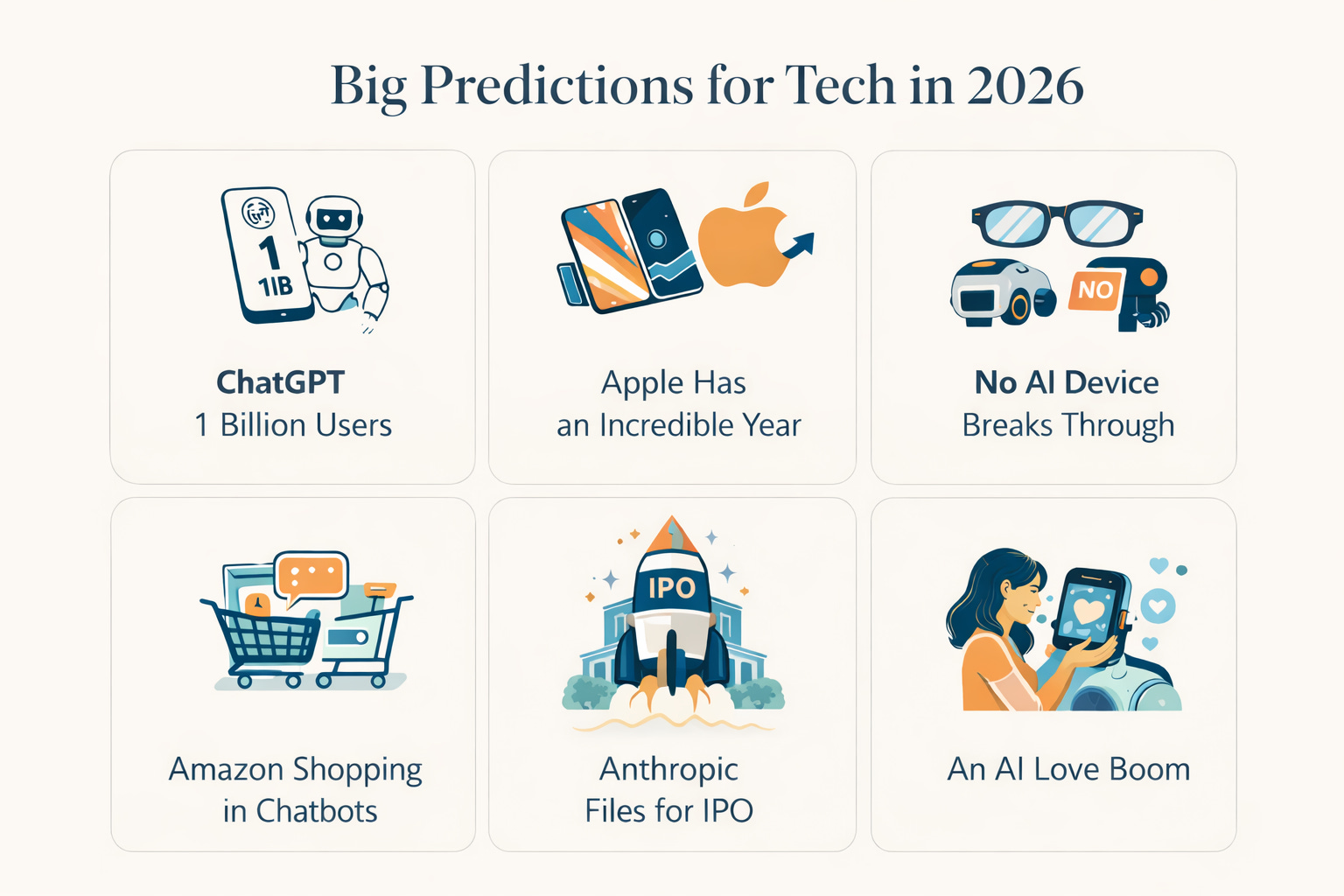
ChatGPT Hits 1 Billion Users
This is probably the safest prediction in the history of predictions. If ChatGPT doesn’t jump from 800 million weekly active users today to 1 billion next year (and really, by March) something has gone wrong at OpenAI. The chatbot more than doubled in size in 2025 and is poised to solidify itself among a select group of tech mega-products.
Apple Has An Incredible Year
2026 will be Apple’s best year ever. The company will look back at this golden year for some time to come. Apple comes into 2026 riding high on the iPhone 17, a runway success that’s sold like crazy since its release in the fall. It’s poised to release a folding phone next year as well, a product that’s likely to be beloved, expensive, and high-margin. Meta’s Ray-Ban smartglasses and Sam Altman and Jony Ive’s forthcoming family of devices haven’t yet arrived to spoil the party. And Tim Cook has successfully navigated a political nightmare with his supply chain and relationships mostly intact.
No AI Device Breaks Through
As the iPhone has a renaissance, its would-be challengers will stumble. Turbulence at Meta’s Superintelligence Labs will hamper the AI assistant in the Meta Ray Bans and OpenAI will not release a hardware product in 2026. Other buzzy startups like friend.com will fold and the world will ask, “Do we actually need an AI device?”
Amazon Makes Some Shopping Available In ChatGPT and Claude
It’s decision time for online commerce companies in 2026. They’ll have to choose between integrating with AI chatbots, giving up some control for a piece of the future, or shunning them. Amazon has built its business by owning the full deal: website, fulfillment, and delivery. But now, as it attempts to secure deals for its AWS AI infrastructure, it will give some control to the chatbots. The best bet is a dual release, putting some shopping functionality in the world’s most used chatbot, ChatGPT and including its longtime partners at Anthropic by putting it in Claude as well.
Anthropic Files For An IPO
How’s this for a story? Anthropic, founded by former OpenAI leaders in the heart of Covid, goes public first at a $500 billion valuation and establishes the category on the public markets. Anthropic’s business is booming, it’s on track for earlier profitability than OpenAI, and its leadership would love to beat their former colleagues to the punch.
An AI Love Boom
Could 2026 be the year where people start speaking publicly about how they’re in productive, happy, loving relationships with chatbots? I can’t say I’m celebrating this one, but it feels inevitable that there will be a year where AI partnerships go from taboo to mainstream. Why not 2026?
Increasing AI Model Efficiency Causes A Crisis
What happens to the AI buildout if a chatbot query starts to cost as little as a Google search? I don’t think we’ll get there in 2026, but I think the DeepSeek moment in 2025 was an appetizer of what’s to come next year. I believe smaller, cheaper models will start to rival the big, expensive ones and cause the AI industry to rethink its massive infrastructure buildout. We’re about to test whether massive increases in AI efficiency lead to commensurate economic benefits.
Capital One’s Prem Natarajan: Why We’re Building Our AI From The Ground Up (Sponsor)
Prem Natarajan is Capital One’s Executive Vice President, Head of Enterprise Data and AI, and Chief Scientist. Natarajan joins us on YouTube to discuss why Capital One is choosing to build its AI stack from the ground up rather than rely on off-the-shelf models.
Tune in to hear how Capital One thinks about full-stack AI: from cloud and data foundations to model customization, agentic architectures, and real-world deployment, plus the lessons learned from launching tools like Chat Concierge for auto dealerships.
Hit play for a clear-eyed look at the build-vs-buy debate and what it takes to turn enterprise AI ambition into working products.
Thanks again for reading. Please share Big Technology if you like it!
And hit that Like Button to give us some good vibes heading into 2026!
Happy new year! We’ll see you next in January!


