

When Meta introduced its Muse personal agent earlier this month, I thought it would fail for two reasons: First, privacy concerns would limit people’s willingness to connect it with services like Gmail, thus limiting its utility. And second, Meta built it on non-frontier AI models, exposing it to obsolescence should top labs like OpenAI choose to compete with it.
Well, a few weeks later, it’s apparent I was wrong on one key element, and that miss could be an indication of where the AI business is heading, and a real cause for concern for the frontier labs. Though Muse is still far from a runaway success, tallying below 1 million daily active users even as Meta works hard to promote it, the app works quite well even without access to the top models.
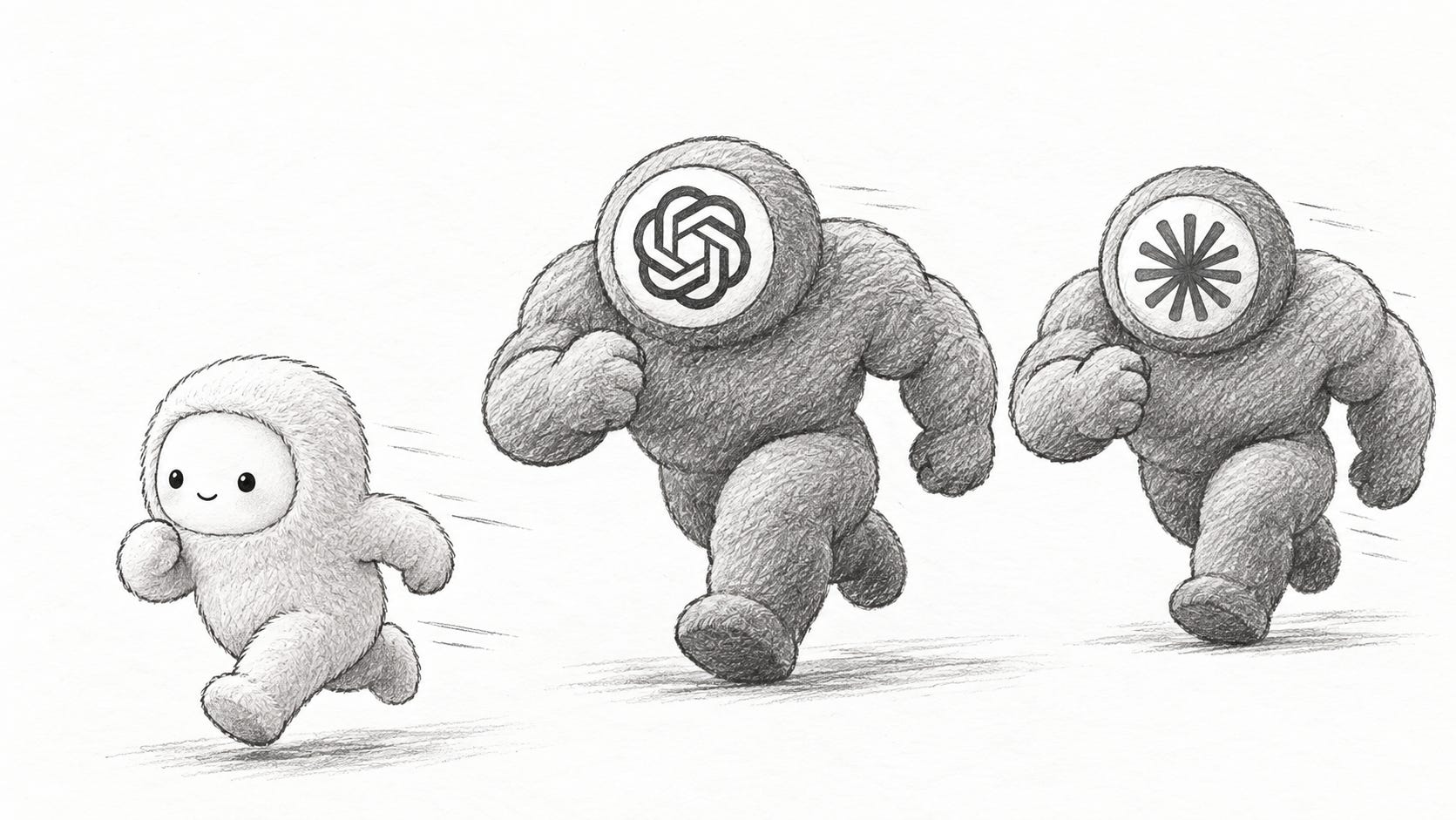
Meta, it turns out, didn’t need frontier intelligence to build a really good AI app. Today’s ‘next-level-down’ models were good enough.
As the frontier labs spend hundreds of billions of dollars to develop the next levels of intelligence, the cheaper, standard models have become so competent that paying premiums for frontier intelligence is becoming harder to justify. Meta’s Muse success is the most public example. But over the past month, dollars have moved from frontier to standard models at a fast rate. At the start of August, 53% of AI dollars went to the frontier models, but that dropped to 45% by the beginning of September, according to a study by Ramp.
“The revenue growth path for OpenAI and Anthropic has weakened due to competition,” said Ramp chief economist Ara Kharazian. “And that competition is from *other* US models, not China / open source.”
The ratio of AI spend heading to frontier vs. standard models has vacillated over time, to be sure, but the arrow is going in the wrong direction for the top AI labs. And a big part of this is standard models’ ability to effectively use harnesses that hook into different tools to get things done. My podcast partners Ranjan Roy and Sheel Mohnot have argued this convincingly on Big Technology Podcast and This Is The Point respectively, and we’re now seeing it in practice.
Standard AI models’ increased competence is also emerging at a time when AI buyers are looking to modulate their spending. They’re done ‘tokenmaxxing’ and are seeking to spend efficiently. With the rise of model routers, which direct spend to a variety of capable models and not just the frontier, these companies are seeing that cheaper models can often work just as well in many use cases and are directing token spend their way.
And the standard models aren’t just a bit cheaper than the frontier, they can be orders of magnitude less expensive. OpenAI’s GPT-6 Astra, for instance, costs $10 per million input tokens and $50 per million output tokens while Meta’s Muse Spark costs $1.25 per million input tokens and $4.25 per million output tokens.
As OpenAI and Anthropic head toward trillion-dollar (or multi-trillion-dollar) IPOs, their ability to extract a premium on expensive-to-develop frontier models is one of the biggest variables investors will have to reckon with. It is certainly plausible that standard models’ increasing intelligence will make it reasonable to pay for the frontier only in select use cases. And in recent weeks, we’ve gotten a glimpse of what that might look like.
Innovation needs infrastructure (sponsor)

AI in finance is only as good as what it knows. Plaid makes permissioned financial data not just accessible, but understood: a paycheck read as income, an irregular pattern recognized as risk. That understanding can’t be prompted into existence. It’s infrastructure, built for finance.
Plaid makes AI work in finance.
This Week on Big Technology Podcast: YouTube CEO Neal Mohan: Why We’re Betting On AI And Not Afraid Of It

Neal Mohan is the CEO of YouTube. Mohan joins Big Technology to discuss how AI is reshaping what we watch and create on the world’s largest video platform. Tune in to hear how much creative control should go to algorithms, how YouTube plans to handle AI slop, and whether AI answers could take views away from creators. We also cover YouTube’s partnership with Google DeepMind, Netflix’s push into podcasts, NFL Sunday Ticket, and changes to how YouTube counts views. Hit play for an inside look at YouTube’s AI strategy and what it means for the future of entertainment.
You can listen on Apple Podcasts, Spotify, or your podcast app of choice
Thanks again for reading. Please share Big Technology if you like it!
My book Always Day One digs into the tech giants’ inner workings, focusing on automation and culture. I’d be thrilled if you’d give it a read. You can find it here.
Join Big Technology’s Private Discord Server!
Where we’ll talk about this story, the latest in AI, the week’s podcast, and plenty more. You can sign up via the link below: