

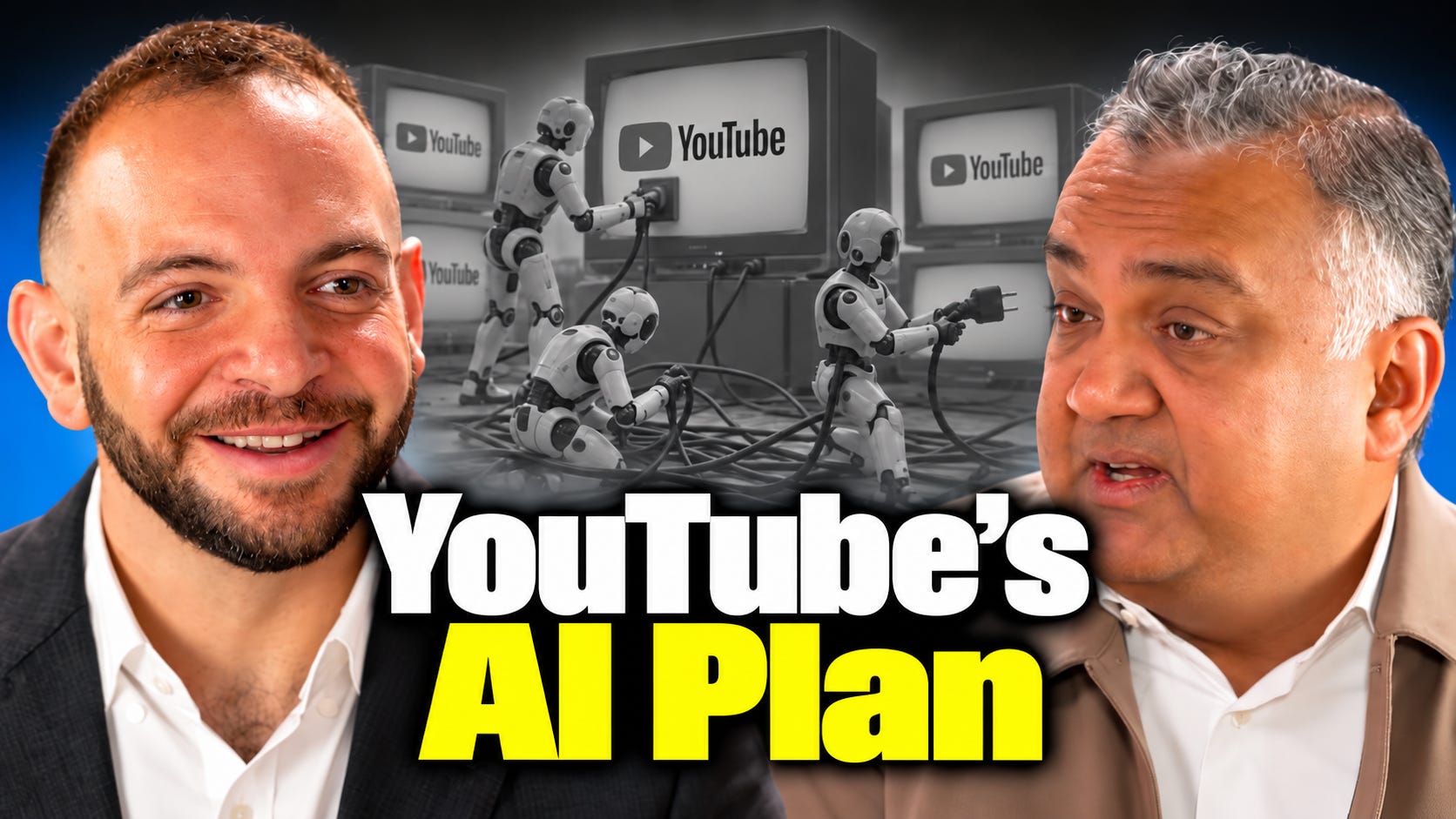
YouTube CEO Neal Mohan is betting that AI will help creators build bigger audiences without displacing the human connection that brings viewers to the platform.
In an extended interview on Big Technology Podcast, Mohan described AI as a tool for improving the “stage” YouTube provides its creators. That includes tools to test videos, tailor thumbnails to different audiences, and answer viewers’ questions about what they’re watching. But as AI takes a larger role in shaping videos and their distribution, how much creative control should people hand over?
“It’s not about the AI picking the content; it’s about us as viewers picking the content, the exact content that we want,” Mohan told me. “Nobody gets to tell us on YouTube what’s good, what’s not good, what’s art, what’s not art.”
Mohan also pushed back on the idea that AI-generated videos should be judged as a category. YouTube wants content that connects with an audience, he said, while taking the risk of low-quality AI content seriously. “I would never want our YouTube Shorts experience to basically become that,” he said of AI slop.
In our conversation, we cover the tension between algorithmic optimization and creativity, YouTube’s close collaboration with Google DeepMind, and whether AI answers could take views away from the creators supplying the information. We also discuss Netflix’s pursuit of podcasters, NFL Sunday Ticket, and changes to YouTube’s view counts.
The full Q&A follows, lightly edited for clarity, with filler words, repeated phrases, and podcast transitions removed.
YouTube’s Growing Influence
Alex Kantrowitz: When you moved from Google’s ad division to YouTube in 2015, I tweeted that you were off to make them some money, and it worked. YouTube is now a $60 billion annual business, compared with Netflix’s $45 billion, with more than 2 billion users globally and 13% annual growth. It accounts for 14% of all U.S. streaming.
That means a billion daily hours of YouTube are watched on TV alone, and the company’s paid out $100 billion to creators over the past four years. When we talk about YouTube, it’s not just the cat on the skateboard or the dog on the skateboard anymore. This is a media force.
Neal Mohan: The first thing that comes to mind when you mention that tweet is time flies. It’s been a long time, and YouTube is really everything that you described it to be. We celebrated our 20th anniversary last year. You’re right: We’re this platform that started as a place where you would upload videos like the ones that you described, and now we are a streaming service where 2 billion-plus people come to every single day, connecting with millions and millions of creators.
In essence, that’s the magic of YouTube. As a result of all of that fandom that manifests on YouTube every day, that’s what creates the business opportunities for our creators, for our partners, for the brands that work with YouTube. But also, probably even more importantly, it creates the cultural phenomenon that is YouTube. That’s super exciting.
Should AI Program What We Watch On YouTube?
How much do we want to let AI program what we watch on YouTube? This is AI effectively making programming decisions, as opposed to creators listening and intuiting, or having those programming decisions made by humans.
It’s an interesting way to frame the question, Alex. At the big-picture level, we do use AI a lot. Most of the people that work for me are software engineers. Our job, as I always describe it, is to build the world’s best stage. But it’s our amazing creators, including yourself and all the success you’ve had around your channels on YouTube, that are the people on that stage. That’s the mental model I would ask people to hold in their heads.
If you walk the halls of YouTube every single day, you’re going to hear that term creator or podcaster or artist — creators writ large — a hundred times a day. The way I think about AI is in that context: How can we use the latest and greatest technology? We work with companies like Google DeepMind every single day to make that stage even better.
It’s about doing what YouTube does, helping creators build an audience and then build a business, but doing it more efficiently and faster. A lot of those features and products you described, including some of them hot off the press that we’re going to talk about at Made on YouTube, are powered by AI, but they’re doing things that are core to the creator business.
Dynamic thumbnails: Why not give creators the ability to have multiple thumbnails associated with their video, depending on who the audience is? A/B testing is a concept that’s existed for a while. Why not allow AI to put that in the hands of every single creator?
Those are all powered by our investment in AI using Gemini. Our creation tools, being able to hit the plus button on YouTube and create videos, are powered by models like Omni. But it’s all in the service of human creativity: what creators are looking to do around their creative ideas, but also around their business ideas.
Going back to the core AI use in YouTube, when you open the app on the television screen, those recommendations you get are so relevant and useful to you as a viewer because of our investment in AI. That’s how you should think about our approach to the technology: as a tool to empower human creativity and bring those billions of fans much closer to their favorite creators.
YouTube’s access to AI gives it a real advantage, but art has always involved throwing something out there before knowing whether an audience wants it. Creators respond to incentives, so they’ll follow AI’s suggestions about what to make and where to edit if they think it will help them grow. Is it a good idea to hand those creative decisions from our hands to AI’s?
The way I would answer that question is to frame it a bit differently. Implicit in what you said is that we, as the ones coming up with the creative idea or picking and choosing the right type of content, know better. We get to decide what to put in front of the audience. That’s the way traditional media and Hollywood have worked for decades, and it’s been amazing. Lots of great art has come out of that.
From the very beginning, YouTube’s approach has been very different. Our mission is to give everyone a voice and show them the world. The first part of that mission means something very specific: There are no gatekeepers. Nobody’s saying, “Alex, that idea is cool, but maybe you shouldn’t try it, or maybe you should do it this way.” You get to decide as the creator: This is how I want my podcast to be. This is what I want it to stand for. This is what Big Technology is going to represent and fill this niche in the industry. It’s your choice.
I often say, replace that word AI or algorithm with audience. It’s the audience that is choosing. That’s the difference between YouTube and other platforms. It’s not about the AI or the algorithm. That’s the stage. What you’re seeing in YouTube every single day is the audience giving you feedback.
Why should three or four people sitting in Hollywood make all those decisions for all of us as viewers? Why can’t the 2 billion viewers who come to YouTube every single day make decisions for themselves about what they like and don’t like? It’s that entrepreneurial, creative energy that exists on YouTube every day that has allowed millions and millions of creators like yourself to flourish.
It’s not about the AI picking the content; it’s about us as viewers picking the content, the exact content that we want. Nobody gets to tell us on YouTube what’s good, what’s not good, what’s art, what’s not art. We get to decide. That’s the power of an open platform like YouTube.
I’m much happier with YouTube’s version of the world because Big Technology probably wouldn’t exist with gatekeepers. We don’t need The New York Times to publish articles about technology or HBO to make this show.
You said something very interesting as a creator, which a creator understands intuitively: how to make tweaks, how to respond to feedback. You described it in the context of the algorithm. That’s just the audience giving you that signal.
The other place where you get feedback instantaneously is right below your video on the watch page. Those comments are telling you whether you should do audio versus video or what have you. That feedback is instantaneous. It is literally your fan base, your audience, your listeners, your viewers, telling you exactly what they think about what you just did. Then it’s your choice how to incorporate it or not incorporate it, as opposed to having ten middlemen in between deciding that for you, or that feedback coming three months later after the season is done and it’s too late.
Will All the Videos Look the Same
YouTube has hit shows and is leaning into shorter miniseries, with production that rivals legacy media. But could algorithmic optimization make everything look the same, the way “Instagram face” has encouraged people to adopt the same pose? How do you guard against that homogenization?
I think that’s just not the way YouTube has worked. You’ve followed the YouTube story almost since the very beginning. I have as well, and I think it honestly ends up being almost the complete opposite.
Because of this lack of gatekeepers, because of this entrepreneurial creativity that YouTube allows, as you described in your own case, there are millions and millions of fandoms and niches that emerge. The YouTube experience is a bit of the opposite: When you turn on the TV, you get very specific episodes or shows or creators based on your interests.
It turns out there are millions of other people who also have those interests, so those niche cultural phenomena are not tiny. They’re large because of the 2 billion people that come to YouTube every day. But they really are millions and millions of these types of niches.
The same thing happens to me in my experience. It changes through the course of the year. I go to YouTube because I love to learn random, esoteric things sometimes, but I also go because I love sports, and that’s as mainstream monoculture as it gets. YouTube gives you that full spectrum as opposed to any homogenization.
Because we are used so broadly, all over the world, it’s very hard for that kind of homogenization to happen. It’s more about these niche interests that are also followed by a million of your closest friends.
MrBeast sets trends that other creators follow, particularly in how he looks at the camera in his thumbnails—
Are you doing those in your thumbnails? I’m going to pay closer attention.
We’ve found that looking concerned or laughing works better than the shocked expression. But there has been some algorithmically driven homogenization on YouTube, even if it’s only in certain elements, hasn’t there?
I think there are up-and-coming creators that look to Jimmy, given his success on YouTube and in the culture, as a blueprint they should try to follow. I think that has always been part of the YouTube creator culture.
Mimetic to a degree.
No, the aspect of: If you’ve made it, your job is to help the next generation of creators come along. I think creators like MrBeast and others really lean into that. But there is that aspect of trying to learn from creators who have been successful.
What I’m commenting on is this notion of homogeneity across all of YouTube. We don’t see that in the data. One of my favorite questions when I’m at an event or hanging out with friends is to ask what their favorite thing is to watch on YouTube. I’ve been asking that question for a decade now, and I almost always get a completely unique, different answer. I think that is more the essence of the experience on YouTube, and frankly, where the longevity comes from.
AI might be helping more with packaging, through dynamic thumbnails and the A/B testing that already exists for headlines.
It helps with all of those things, but it gives us a different set of toolkits that help with different aspects of YouTube. One of the core parts of YouTube that I know you’re familiar with is Content ID and protecting creators’ rights and their IP. That was an investment in AI well over ten years ago. It’s deeply rooted in every aspect of the company and the product.
There are places where it’s more visible, for example those creation tools right behind the plus button on the main app, but there are places where it’s deeply embedded into how YouTube works.
AI Videos and AI Slop
When you think about the content you want on YouTube, do you want AI-generated content?
The way I look at it is, we want content that connects with viewers and fans all over the world. I sometimes say YouTube is the world’s most efficient connector of a creative idea or creative person with their audience, no matter where that audience is in the world. To the extent that is the core of what YouTube does, I want more of that type of content.
Whether AI is used as a tool to create that content is a manifestation of the state-of-the-art technology that exists today. I do believe it is YouTube’s responsibility to make sure our creators, like yourself, have access to those tools. But it’s the creator’s choice and responsibility to choose which tools to use and how to use them.
What I find is, when viewers come to YouTube, it’s that human story or human connection they’re looking for, and that type of content tends to rise to the top. AI, in that sense, is not different from other types of technology that enabled creativity in the past, whether it was the advent of the synthesizer when we were growing up or the drum machine. There’s always technology that comes along that enhances the artistic experience.
But what’s also true is that there’s a human being who is the maestro controlling it. That’s at least so far what we’re seeing on YouTube. I see it in videos. You probably see it too: the use of these new technologies to create a palette of content that otherwise might not have existed. But it’s all in service of that human storytelling.
That’s what we’re seeing on YouTube, both on the Shorts side and on the long-form side, because I think people come to connect with humans. Two computers have been able to play chess against each other for a very long time. It’s really only interesting on YouTube if at least one of them is human.
Some of the AI videos are getting good. Did you see the video recently that’s been trending of the Coke truck that sprung a leak?
I haven’t seen this.
Neal, you’ve got to watch this: A Coke truck springs a leak, and a man fills a gallon jug from the stream and starts chugging it. He opens the Mentos truck next door and dumps the Mentos into the Coke on the sidewalk. The mixture creates an explosive propellant that he stands on and rides out of the frame.
How many times did you watch it?
Many times — it was most of my weekend, actually. I wouldn’t call that AI slop; it’s good.
You’re hitting on a key point there, Alex. You asked at the beginning how I think about AI-generated content. Do I want more or less of it? That’s not the dimension along which I think. Hopefully my answer conveyed that AI technology might be a means to that creative end, but what rises to the top is new creative ideas and concepts and things that resonate with creators’ fans.
There isn’t an explicit “AI bad, everything else good,” or vice versa. All the rules, starting with our content policies on our platform to what resonates with audiences, are independent of that factor.
You’re saying, basically, if it’s good, it’s okay.
Yeah, I think so. What comes through, even in the example you described, is some aspect of storytelling. The technology is evolving so fast that it’s also very easy to create low-quality content. That’s more the dimension to look at, whether it’s referred to as AI slop or what have you. That’s different from AI per se. It’s about high-quality content.
YouTube won’t penalize content if it’s AI off the bat. They’re going to give it a shot.
Not purely on that aspect of it. What constitutes AI? Did you use some tool to do this five-second thing in your video, or this in the background? People have been doing that since the beginning.
Purely AI content.
Even there, how do you draw the line? How is that put together or not? It’s got to be more about the quality of the content and what’s resonating with an audience, and having that rise to the top. We take the notion of AI slop very seriously. I would never want our YouTube Shorts experience to basically become that, or any of our experiences or surfaces on YouTube to become that.
The term AI slop: You believe there’s a thing called AI slop, and you don’t want it.
I think you’ve seen it. I’ve seen it.
I’ve made AI slop, though I try not to upload it on YouTube. I’ve thought about creating a channel that puts the day’s tech news through NotebookLM, generates a video, and uploads it. That seems on the border between slop and something of interest.
I think it depends on—
How the audience responds.
Not just how the audience responds. Yes, that’s important, as we talked about earlier, but also how you, as the creator, feel about the content of that video. Does it carry forward what you stand for editorially? Is it something your audience expects from you, or is it just some random video that’s uploaded? Those things matter, and that’s what goes into what succeeds on YouTube versus not as well.
Since the development or inception of these AI tools, have you seen an increase in uploads on YouTube? Has the curve bent?
I don’t think necessarily directly correlated to that. YouTube continues to grow. It continues to be a place where new creators are finding an audience every day.
Sometimes I get asked, “Who are the most important creators on YouTube, or who do you think about the most?” What I always say is, the most important creator is actually that person who’s hitting the upload button for the very first time today, because that’s the lifeblood of YouTube: creating an opportunity for the next Alex to come along and start uploading today.
As YouTube has become this cultural phenomenon, there are many more creators, millions of them, trying their hand at it. I think that’s independent of this question of AI or not. Does AI make some of this content creation easier and further democratize it, just like YouTube did in the early days, 20 years ago? Of course, and I think that’s a good thing.
Competing With AI Chatbots
Netflix’s CEO has said his competition is sleep. People can watch YouTube on TV while scrolling Shorts on their phones, but there’s still a limit to their attention. Do you view AI as competition for that time?
Do you have YouTube TV? You can do multiview on it. I watch four games at once.
I mostly watch YouTube, Netflix, and HBO on my computer and phone. As conversational AI gets better, I think it will become an entertainment medium that commands more of people’s time. When you plan for the competitive landscape, do AI chatbots register as something you’ll have to fight for attention with?
I’ve been in this business for a very long time, even before YouTube, at this media and technology intersection, and it’s always been competitive. There’s always been choice. There’s never been a more dynamic time, full of choices for all of us as consumers, than today. On balance, that’s a good thing. It allows all of us as consumers and viewers to be in the driver’s seat, which is the way it should work.
The best way to answer that question is, our focus is that when you’re on YouTube or thinking about coming to YouTube, we really are giving you the best experience possible. That’s our North Star. That’s how we think about our business. Are we relevant?
We have this notion on YouTube of long-term satisfaction. Not just satisfaction as a viewer or consumer in the immediate term, but something that feels like a worthwhile use of your time, your most precious commodity, over the long term. That’s how we think about our product and business. It’s how we govern ourselves. Hopefully that gives you some insight into how we think about these trade-offs, because those are your choices.
You get to choose, and it’s not just about an immediate sugar high. Do you view it as valuable time over the long term? We’re a place where we have every type of format, from 15-second Shorts to 15-minute VODs to hour-long podcasts to three-hour NFL games to 15-hour livestreams. We attempt to cater to whatever our viewers are demanding when they come to YouTube. That’s how we think about our products.
If we reached AGI or an intelligence explosion, talking with AI bots could become much more engaging. That’s something I’d want to plan for in your shoes, but it doesn’t sound like you’re sweating it yet.
It’s an incredibly dynamic time, with lots and lots of choices for people. One of the things that’s interesting about YouTube is that we, as human beings, as a human species, have engaged in and appreciated human storytelling, human connection through storytelling, for thousands and thousands of years. That’s what happens on YouTube. I think in the future, that aspect is not going to change.
As long as YouTube can remain core to that — this summer was a great example, everything from Justin Bieber at Coachella livestreaming on YouTube to the 1.7 billion people all over the world who watched some FIFA content on YouTube during those amazing six weeks, or even a creator like Markiplier, who took his audience along on his channel while he built this movie, released it in thousands of theaters all over the country, and became the number-one movie in Hollywood over the weekend of its release.
All of that is about this long-term human storytelling connection between creators and fans. That’s what I focus on, because whatever world comes in the future, that aspect of deep human desire is not going to change.
Working With Google DeepMind
Neal, we go way back: I’ve been covering your work since 2010, so 16 years. There aren’t many people I can say that about.
I feel young at heart. Like you were saying before the break, it’s probably the craziest, most interesting time to be in tech.
I see some ad-tech DNA in today’s announcements: Advertising is about getting the right ad to the right person, and YouTube applies similar optimization to videos. Creative optimization is central to advertising, and now creators can A/B test videos.
There are common aspects there, for sure. You’ve covered this media landscape forever, so you understand these nuances extremely well. Both those examples, whether it’s advertising, what we’re doing for our brands and viewers, or what we’re doing for our creators and viewers, have some common elements.
One is what I was describing earlier: It has to be worth the viewer’s time. That’s the common element. We all, as consumers and viewers, have lots and lots of things coming at us. That’s only increasing, to your point. It has to be a good use of our time when we’re on YouTube. Giving creators the tools to do that for their audiences is really important.
A lot of what we focus on is not just the features you experience in the main YouTube app on your phone, desktop, or television screen, but actually in YouTube Studio itself. That’s where a lot of the AI goes, because those are the tools our creators use every day to make those connections.
There’s some commonality there. We do the same thing in trying to bring those tools and capabilities to brands as well. Increasingly, some of those lines are merging. Some brands are thinking about themselves as creators on YouTube first and foremost, even before they think about the first dollar they’re going to spend on media.
My understanding is that Google DeepMind operates an “engine room” that makes AI advances available to products like YouTube, Maps, and Gmail. YouTube seems particularly aggressive about using those advances, from Ask beneath videos to Ask Studio for creators. How does that collaboration work, and why have you moved so aggressively?
First and foremost, YouTube works very closely with Google DeepMind on a daily basis. We have teams, starting at my level with my counterparts, Demis and Koray, but probably even more importantly, at the working-team level every single day. I can give you examples of those.
It has been a big focus of mine and YouTube’s, both on the creator side and all those creator tools, including many we’re announcing this week, but also on the viewer side and the brand side. All facets of stakeholders at YouTube have benefited, I would argue, over the last two, three, four years from our very heavy investment in AI and our partnership with DeepMind.
But I would say that is pervasive across all of Google and all of Google’s products, through and through. I see that from my perch regularly.
I get much better results searching YouTube videos than searching Gmail with Gemini, where I have to use ChatGPT. Ask Studio and Ask underneath videos seem to work much better—
Ask is a deep collaboration, as a good example, between YouTube and Google Gemini. That’s why you see at the bottom of every YouTube Ask session a link out to Gemini in case you want to go deeper. Hopefully you’ve found that to be pretty seamless.
Asking Questions About a Video
Should we tell folks about this Ask button, in case they’re not familiar? There’s an Ask button underneath every video now, where you hit the button and a conversation pops up, and you can talk to YouTube about the video.
What’s your favorite set of use cases? What do you like to use it for?
I use Ask constantly while training for a race, to get the key advice from running videos that sometimes stretch past eight minutes for mid-roll ads. If a video isn’t getting to the point, I ask what it’s telling me to do and how it works. I also use it to generate timestamps and find whether a video covers a specific topic.
Those are all great examples, and clearly you are a heavy user of it.
I’m an Ask junkie.
I use it a lot too. I have found myself using it in use cases I wouldn’t have expected. You gave some clear examples of your running journey, how it helps you with that and makes you a better runner.
I’ll use it even in entertainment situations. I have two young daughters. If I’m listening to a music video with them, I can ask about the inspiration of the lyrics, or what she meant by this very specific thing. It’s a super-fun use case that allows me to enjoy the music and music video, but go a little deeper with the artist. It’s this organic, natural way of engaging with YouTube. It brings me and my daughters closer to that particular artist.
Back to your core question of how it came about and how that partnership works: That is a classic example of daily, almost blended teams across YouTube and Google DeepMind, because it is powered by Gemini. You get a sense of that in the experience.
What we did in the YouTube context specifically is make it about that video you’re engaging in. The reason I point that out is it’s a way to deliver something for you as a viewer or consumer, but bring the creator into the fold too. That’s what makes the experience unique to YouTube: It is about the video. It’s about what the creator is saying in that video.
You’re describing an example where sometimes you want to get to the point around a particular thing, but there are many other examples of going deeper about a particular concept in the video or jumping around. We wanted to create something that worked really well for our viewers and listeners, watchers, users, but also for our creators. That Ask experience is a version of that.
You should expect us to continue to innovate on that experience. One example is what we announced at I/O a couple of months ago: to bring that similar type of conversational experience, video-forward, creator-forward, to the search experience on YouTube as well. I’m very excited about that. I don’t know if you’ve played around with it.
That’s launching today, right?
We’ve had a version available on desktop. We want to bring it to other surfaces, including the biggest screen in your home, where, as you said, lots and lots of people watch YouTube. There, of course, you have the challenge of voice activation and things like that.
You can imagine what you can now do through that experience: “YouTube, can you help me plan my trip with my wife to Paris?” It’s a list of videos, but maybe it’s more than a list of videos. Maybe it’s specific points in the videos. Maybe it is some text describing how to set up an itinerary step by step. A much richer experience, just as you’re familiar with Ask on the watch page.
As you can tell, I’m getting very excited about this. This is an example of close collaboration between DeepMind, Gemini, and YouTube to deliver a really big win for billions of viewers who come to YouTube every single day.
Will AI Answers Take Views Away From Creators
YouTube’s AI search can pull useful information from several videos and present it as text. But a creator might have invested heavily in a 15-minute marathon-training video, only for viewers to get all the advice without watching it. How does that change the equation for creators?
There’s a lot to that question. The first thing I would say is that the Ask experience is video-forward; it’s creator-forward. It will surface those videos. One of the things unique about YouTube that it can bring to this experience is video.
It turns out a lot of learning, your running examples being really good ones, is: Text is okay, but you have to watch the video or engage in parts of it to understand deeply what the concept is. How to fix a garage door: That’s a video, step-by-step type of experience, and only that Ask YouTube experience can bring that to the fore.
That’s what we’re seeing, and that’s why, generally speaking, you don’t see an impact on the consumption of those videos as of yet. Obviously, this is all new.
The other thing to keep in mind is that in the grand scheme of engagement with YouTube, this is a sliver of that. Lots of YouTube is about watching your favorite documentary on a television screen, and that’s the experience.
The third thing I would say is that these new experiences are going to be ways to surface fresh pieces of content, or content that might not have gotten a lot of views because it actually has, out of a ten-minute video, this two minutes of gold that’s getting at the essence of this very esoteric query you might have asked in Ask YouTube that previously wasn’t being surfaced in the right way. That, I would argue, is a win for that creator, but also for you as a viewer or a person trying to learn something on YouTube.
NFL Sunday Ticket and Live Video
I signed up for NFL Sunday Ticket, but because I live in New York, I couldn’t watch the Jets. How do you address those blackouts?
Presumably because that Jets game was a national game.
Maybe YouTube was doing me a favor by blocking the game.
Jets — there’s always hope, right?
One and one.
That’s a good start. We follow the rules. Sunday Ticket is an out-of-market package. That’s the way it’s designed. If it’s in your home market and it’s the Jets, they’re going to be available through your broadcast partner. Or the game might be a national game, in which case it’s also available outside of Sunday Ticket, but available to you.
Whether you’re away from your favorite team or interested in a different set of teams, that has been the core value proposition of Sunday Ticket. We’re on season four now. Every year, we try to bring some innovation that expands the market a little bit, innovates in terms of how we bring creators to the table. That’s the long answer to your Jets question.
It’s a league question.
It’s certainly a league question, but it’s also one of national versus local, and the fact that Sunday Ticket is this out-of-market package.
When it comes to live content, Netflix is going big into trying to do more live. How much of that do you want to program yourself, or do you want to buy it, license it, or make it available?
The interesting thing about live content and live sports in particular, at least how I think about it, is the nice thing about live is it programs itself. We have a deep partnership with the NFL. They have been great partners on this Sunday Ticket journey. But the nice thing is, we don’t script the games. We don’t pick the games. The games script themselves.
In that sense, it’s more akin to what you’d expect to see on YouTube. Coachella is the same way: this live, three-day, times two weekends-long livestream. We’re not deciding what Justin Bieber or Sabrina Carpenter does onstage. They decide. They’re the creators on the stage. That’s how I think about live.
Live has always been a very important part of YouTube. Some of our OG creators were gaming creators. A lot of what they do is livestream. It’s always been a core aspect of YouTube, and that’s how I think about live events, at least in terms of their home on YouTube.
Even this week, a lot of the new products we’re announcing are around livestreaming. Speaking of AI earlier, being able to bring auto-dubbing, one of the killer AI features on YouTube, to the live environment and expand livestreamers’ audiences that way. That’s generally how I think about live.
Netflix and the Competition for Podcasters
Netflix is trying to use successful YouTube podcasts as a growth engine, with exclusivity requirements that I think are a bad choice for creators. How do you respond competitively when that could take some of your top creators off YouTube?
Generally speaking, when I speak with creators — this is not new; this has existed for some time — if a creator finds success off YouTube because of their success on YouTube, I think that’s a really positive thing.
MrBeast, Jimmy, is an enormously successful YouTuber. Look at the amount of effort and creativity he puts into every one of his videos every week. But he has had enormous success outside YouTube: a game show, a book, on and on. That’s valuable because when you go to his offices, one of his first rules is “YouTube first.” He recognizes that YouTube is his home and the font of all that success. Generally speaking, when I speak with creators, that’s the conversation I have.
Given the cultural phenomenon YouTube creators are, and the juggernaut they are in the culture, of course other streaming platform services have taken note. Frankly, that’s flattering to our creators. This is not the first time this has happened. I’ve been at YouTube long enough to know there are other platforms and services that have made a run at this periodically over the years.
Our job is to make sure our creators feel like their primary home is YouTube, and that’s how we engage with them. All these conversations are pretty bespoke, because what every creator is looking for in their business is slightly different. You think about your business differently than XYZ podcaster or XYZ YouTuber. It’s my job and my team’s job to listen to that and create something for you that feels like we’re listening to you on YouTube.
Whether it’s a feature or helping you with brand deals — that’s another area I’m very excited about, connecting creators and brands together.
It’s a good program.
Changing the View Count
Since YouTube changed how it counts views, my videos seem to be getting 30% or 40% more, which feels like grade inflation. What’s behind the change, and should viewers keep it in mind when looking at view counts?
One of my favorite parts about my job at YouTube is anytime we tweak a feature or functionality, the feedback is instantaneous. I appreciate it, good and bad, and that’s happened for years.
The answer on this one is very simple, Alex. We’ve gone from where we started years ago, when that original definition of the view was created, to one where we are multi-surface, multi-format. Everything from these livestreams to traditional VOD videos, long-form videos, to Shorts.
We counted Shorts until very recently in a way that was different from what we counted VODs. You could argue that wasn’t right either. Why, just because this is over a certain time length or done horizontally, would it have a different public view count than what we did on Shorts?
We tried to make those things uniform so they are counted in exactly the same way. We had made that change to Shorts a couple of years ago, or a year — I can’t remember exactly when — but now we want to be consistent across all of YouTube. That’s all we did.
For creators, when you go into Studio, you still see engaged views. You still have that calibration of how you may have thought about a view before. That’s also how our systems work in terms of factoring views into recommendations and those types of things.
It was more about uniformity and simplicity in the product. I view it more as a clarification as opposed to anything that changed. Both those views are still available to creators.
YouTube and the Future of Google
There seem to be two futures emerging for Google: the media and advertising business, including YouTube, and the cloud business. Can those coexist, and which do you think will be the primary Google of the future?
In my mind, that’s pretty clear. I’ve been at Google a very long time. It’s been a real privilege to see all these aspects of Google, and what’s amazing about the company is all of these pieces can be successful within Google: our cloud business, our core businesses, search and ads, and YouTube.
The way I describe YouTube is a little different from the way you talked about it. At its core, it is a technology company. We pride ourselves on our deep product innovation. That’s what YouTube is all about. We’ve had over 3,000 launches this year in terms of bringing the best of technology to this experience. That is the common core of Google in everything we do.
You described how Gemini works with every facet of Google and brings AI to bear across all these products. That’s one facet, but so much of what YouTube does sits on that incredibly deep Google technology stack that allows us to build all these amazing features for our creators, viewers, and brands.
I don’t expect that to change. If anything, it’ll only accelerate over the years to come, alongside the hopeful continued growth of our cloud businesses or whatever other new products and businesses we bring to our users.
Neal, dynamic times indeed. Thank you so much for your time. Appreciate it.
Thank you so much for having me, Alex.