


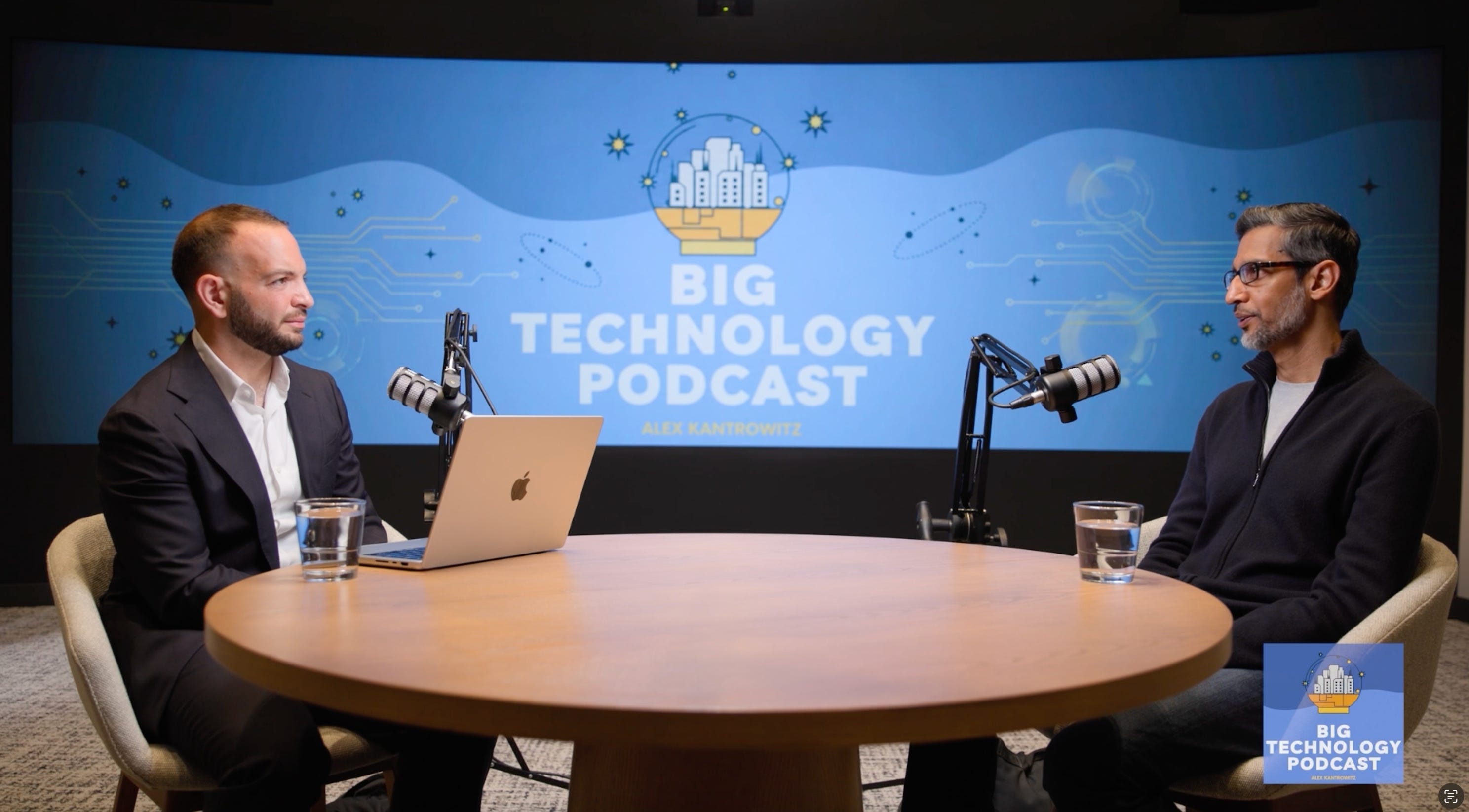
Sundar Pichai believes the tech industry is far from the end state of recursive self-improvement.
The Google CEO shared this belief in a Big Technology Podcast interview this week, along with plenty of other news nuggets.
On Tuesday, we published the full transcript of the interview. Today, we share the eight newsiest bits of the conversation, spanning RSI, compute, and Google’s relationship with Apple. You can get the full interview on Apple Podcasts, Spotify, YouTube, or your podcast app of choice.
Full recursive self-improvement is far away
Some in the AI industry believe that an intelligence explosion is imminent. They say AI will soon improve itself autonomously, in a full loop without human intervention. Pichai, who has visibility into Google DeepMind’s cutting-edge research and is a major investor in Anthropic, disagrees.
“To be very clear,” he said. “We are pretty far from the end state of RSI.”
But AI models are helping make themselves better
Fully autonomous RSI may be far away, but AI models are already playing a major role in improving the next versions of themselves. “You have RSI loops along with AI researchers in various aspects of model development,” Pichai said. “You almost have agents helping AI researchers in some automated way work together to build these models.”
Everyone is short on compute
Pichai said the entire tech industry is short compute given that today’s availability reflects decisions they made two years ago, when the technology was much less capable.
“The compute we have today is a function of decisions I made in 2024,” Pichai said. “Today, obviously, when you sit and look at anything, everyone is short—not just us, other companies—and everyone wishes you had two times what you had planned for.”
Google is sacrificing cloud profits for frontier AI research
Google has limited compute, so it must make tradeoffs between today’s profits and tomorrow’s research. Google Cloud Platform has been growing ferociously over the past year, with 82% growth in the past quarter, and it can make even more profit with more GPUs, but Pichai said “ground zero” for Google is making sure frontier AI has enough compute to thrive.
“Our cloud business is at any given moment in time forgoing short-term revenues because we are making compute trade-offs to support frontier AI development,” he told me.
But Pichai believes some compute constraints are good for AI research
Unlike most AI research outfits, which believe more compute leads to better models by definition, Pichai said some constraints could spark innovation. “Even our AI researchers have some constraints, which are also good,” he said. “That’s what inspires creativity. That’s what helps you come up with a more efficient algorithmic breakthrough.”
Google’s big product ambition is a unified agent where you can use its services
Asked when AI search within Gmail might work as well as Gmail search within ChatGPT, Pichai explained that Google’s priority has been bringing its product suite into a unified agent where services like Gmail will be accessible. This is what he envisions as the future interface.
“You can address this agent whether you’re in Workspace, in Search, in Gemini,” he said. “We are putting a lot of time and effort into making sure, as we build out our agentic experience, that unification and that capability works well across all these services.”
Google’s partnership with Apple is going strong
Pichai said Google would like to do more work with Apple after helping the company improve Siri via the licensing of Gemini. “Apple has done a phenomenal job of incorporating… they customize these models and build it into Siri,” he said. “and it’s been great to see the reception. We are committed to doing more.”
Datacenters in space: “Hello World” moment upcoming
Pichai compared Google’s Project Suncatcher, where it is sending its TPUs to space, to Waymo: A technically challenging moonshot that could pay off perhaps not in years, but in decades. “With all these technologies, you’re at a moment in time where it looks a bit like sci-fi, but 10 to 20 years down the line, it’s actually working in a meaningful way.” Pichai said he expects a “Hello World” moment from the TPUs it sent to space “as we speak.”
A MESSAGE FROM OUR SPONSOR
What Makes a Company Exponential in the Age of AI? — With Anthony Pappas

Anthony Pappas is the chief marketing officer of DXC Technology. Anthony joins Big Technology to discuss what makes a company an “Xponential Enterprise” in the age of AI. Tune in to hear the six principles behind DXC’s approach, how his team is transforming its marketing operations, and how he says those changes helped save $15 million. We also cover AI agents, controlling token costs, and whether companies will build their own AI tools instead of buying more software. Hit play for a practical look at turning AI into measurable business results, kicking off our new series in partnership with DXC Technology.
Thanks again for reading. Please share Big Technology if you like it!
My book Always Day One digs into the tech giants’ inner workings, focusing on automation and culture. I’d be thrilled if you’d give it a read. You can find it here.
This week on Big Technology Podcast: The PHP Bug’s Stunning Consequences + Cybersecurity’s Black October — With Alex Stamos

Alex Stamos is the Chief Information Security Officer at Cognition. Ranjan Roy is the Author of Margins Stamos joins Big Technology to discuss a massive wave of cyberattacks unleashed by AI-discovered software vulnerabilities, including a critical PHP flaw that could put millions of websites at risk. Tune in to hear how hackers are exploiting these vulnerabilities, why AI is accelerating cyberattacks, and what the next several months could mean for businesses and everyday internet users. We also cover China's hacking ecosystem, the risks of giving AI agents access to sensitive accounts, and why Stamos believes we may need to rewrite much of the software underpinning the internet. Hit play for a fascinating and alarming look at how AI is transforming cybersecurity and what we can do to protect ourselves.
